

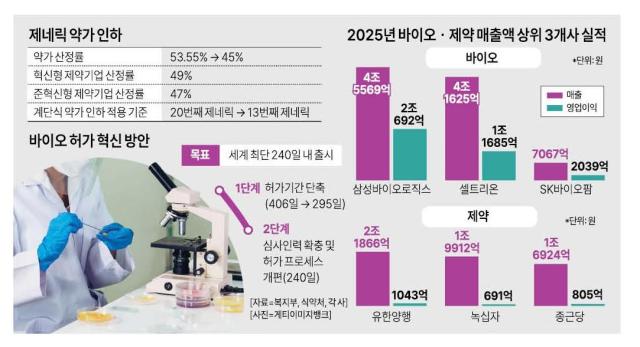
Industry officials said April 2 that Samsung Biologics and Celltrion, the country’s two biggest biotech companies, are each targeting more than 5 trillion won in sales this year.
Both companies have strengthened their positions in global contract development and manufacturing (CDMO) and biosimilars. Samsung Biologics posted 4.557 trillion won in revenue and 2.0692 trillion won in operating profit last year, setting a domestic industry record, and set a 2026 revenue target of 5.32 trillion won.
Celltrion reported 4.1625 trillion won in revenue and 1.1685 trillion won in operating profit last year, and its 2026 sales outlook also tops 5 trillion won. At a recent shareholders meeting, Celltrion Chairman Seo Jung-jin, who returned as chair for the first time in 11 years, presented sales guidance of 5.3 trillion won and pledged step-by-step operating profit of 300 billion won in the first quarter, 400 billion won in the second, 500 billion won in the third and 600 billion won in the fourth.
SK Biopharmaceuticals also posted its best-ever results, with revenue rising 29% from a year earlier to 706.7 billion won. Securities firms expect the company to reach 1 trillion won in annual sales in 2027.
Government backing is also seen as a tailwind for biotech growth. Authorities have said they will pursue licensing reforms aimed at enabling the world’s fastest product launch timeline of 240 days. Earlier this year, the approval period for new biotech drugs and biosimilars was cut to 295 days from 406 days, with a plan to reduce it further to 240 days. A Ministry of Food and Drug Safety official said the agency is expanding its review staff by about 200 to speed biosimilar approvals and will provide active support.
Late last year, the ministry enacted a special law to build a regulatory support framework for the CDMO industry. With a new registration system for export manufacturing of biopharmaceuticals — previously not covered under pharmaceutical regulations — the government plans to support measures including facility standards for export-focused plants, formalizing standards for good manufacturing practice certification and raw-material certification, and simplifying import customs procedures for active pharmaceutical ingredients.
In pharmaceuticals, HK inno.N exceeded 1 trillion won in revenue last year, expanding the number of companies in the “1 trillion won club” to 10. But companies centered on generics are widely seen as entering a fight for survival as price cuts take effect. The government lowered the generic pricing formula to 45% of the original drug price, a move expected to reduce sales and constrain research and development spending. The impact is expected to be significant for both top-tier and smaller drugmakers.
Changes are already being felt in the field. Analysts said companies that have relied on contract sales organizations (CSOs) are likely to face broad shifts in sales strategies. As firms move to cut fixed costs such as labor and marketing, more are expected to drop low-profit, low-priced generics and focus on higher-margin products.
“Developing new drugs is difficult to deliver results in the short term, and it requires large-scale investment,” an industry official said. “Because options to recover costs are limited if it fails, companies have no choice but to start by adjusting expenses they can cut immediately.” As a result, more firms are moving toward conservative management, including scaling back facility investment and revising hiring plans, while also preparing to seek certification as innovative pharmaceutical companies.
A task force for reforming the drug pricing system for industrial development criticized the price cuts, saying, “With the business environment worsening due to rising global instability, drug price cuts carried out now could make it difficult for domestic pharmaceutical companies to survive.” It urged the government to adopt flexible policies that “comprehensively consider public health, insurance finances and industrial competitiveness” so the industry ecosystem is not damaged.
* This article has been translated by AI.
Copyright ⓒ Aju Press All rights reserved.