

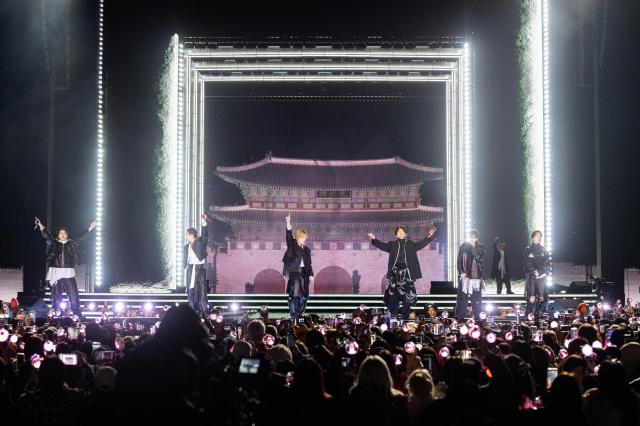
BTS returned as a full seven-member group for the first time in four years with an outdoor comeback stage expected to draw 160,000 people and streamed live worldwide on Netflix. When the group appeared at 8 p.m. on March 21 with Gwanghwamun as the backdrop for the live “ARIRANG” performance, the armor-like costumes drew nearly as much attention as the music.
Behind the scene watched around the world was South Korean fashion brand Songzio, which blended tradition and modernity, toughness and lyricism in the stage looks.
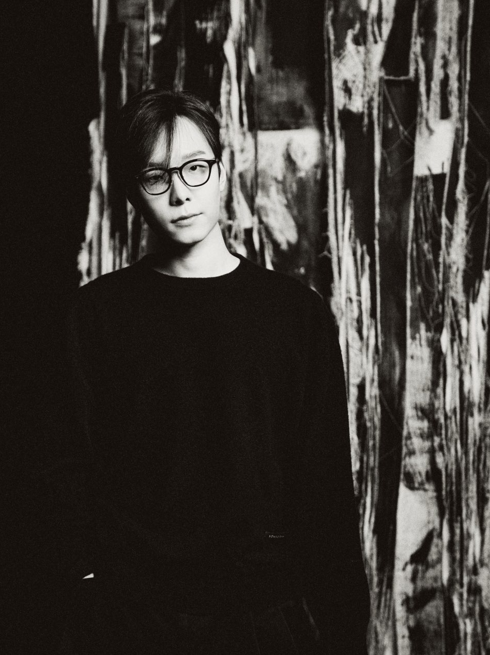
“Clothes are completed when someone wears them. When one person wears different outfits and an impressive look is created, that’s when I feel it’s complete,” said Song Jae-woo, Songzio’s creative director, who built each BTS member’s comeback identity.
Song combined the strength of traditional armor with the flexibility of hanbok, using zippers, draping and asymmetrical structures so silhouettes could shift onstage. He also produced costumes for an 80-member performance team, in addition to the seven members.
The stage personas were set as RM as a “hero,” Jin an “artist,” Suga an “architect,” J-Hope a “sorikkun” (traditional singer), Jimin a “poet,” V a “doryeong” (young nobleman) and Jung Kook a “pioneer.” Netflix said the performance drew 18.4 million viewers.
Song said he aimed to express “a hero of a new era” by combining early Joseon-era warrior armor with the sensibilities of an artist and a traditional singer. “Rather than simply reproducing Korean sentiment, I focused on translating it into futuristic energy,” he said.
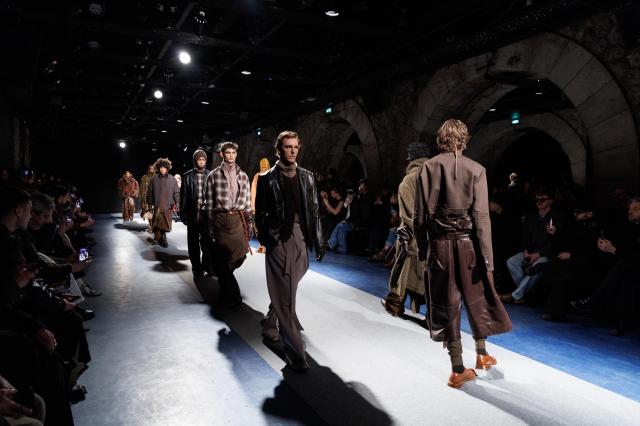
Founded in 1993, Songzio has presented avant-garde menswear based in Seoul and Paris and has recently introduced women’s collections.
The collaboration went beyond making stage outfits, expanding to participation from the planning stage of “ARIRANG.” The concert’s push to foreground Korean elements aligned with the brand’s design philosophy of reinterpreting tradition in contemporary ways.
The collection’s keyword was “Lyrical Armor,” described as “singing armor” — pairing the toughness of traditional armor with a lyrical sensibility to add emotion and narrative to images of protection and resistance.
By combining early Joseon-era armor with hanbok associated with artists and traditional singers carrying the mood of sijo and folk songs, the project sought to portray “heroes of a new era who overcome turbulent history and build a new future.”
Songzio said the project was an attempt to realize the brand’s aesthetics on one of the most widely viewed stages.
“Living with fashion, it naturally becomes part of life. It keeps worldview, art and fashion from being separated in everyday life,” he said.
He said his designs draw on Renaissance and Romantic painting, classical literature and film. “Fashion is similar to film. It’s a genre that combines many fields, and it contains images, an era and stories of characters. I work by imagining each person’s narrative,” he said.
He said he is currently reading Ovid’s “Metamorphoses” and works by Aeschylus.
Another source of inspiration, he said, is “han,” a Korean concept of deep, complex feeling. “I think ‘han’ isn’t simple sadness. It’s emotionally rich, but it also contains the power to move forward,” he said.
He said the project focused not on reproducing that emotion but on converting it into forward-looking energy.
His operating philosophy, he said, is not to be impatient. “Even in a changing world, it’s important to keep what’s yours. If you do, I believe a good opportunity will come someday,” he said.
Asked about differences from the founder, he pointed to repetition. “It’s important to repeatedly imprint the brand identity, because the public doesn’t watch shows every six months,” he said.
He said “authenticity” is his key standard. “Whether it’s minimalism or avant-garde, what matters more than form is persuasiveness. When it’s expressed authentically, I find it beautiful,” he said. “You should be able to answer naturally when asked why you did it. In the end, what’s inside matters most.”
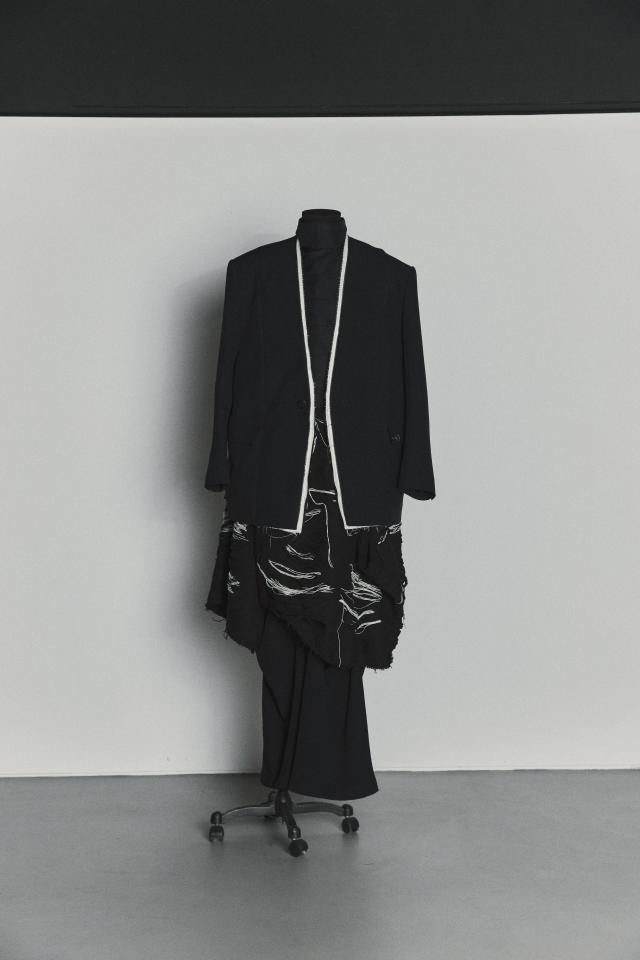
He said he tries to restrain emotional swings and described his aim as “avant-garde elegance,” seeking elegance within the experimental — an elegance he said connects to Eastern sensibilities. He said his frequent use of black reflects a choice to maintain restraint rather than display a specific emotion.
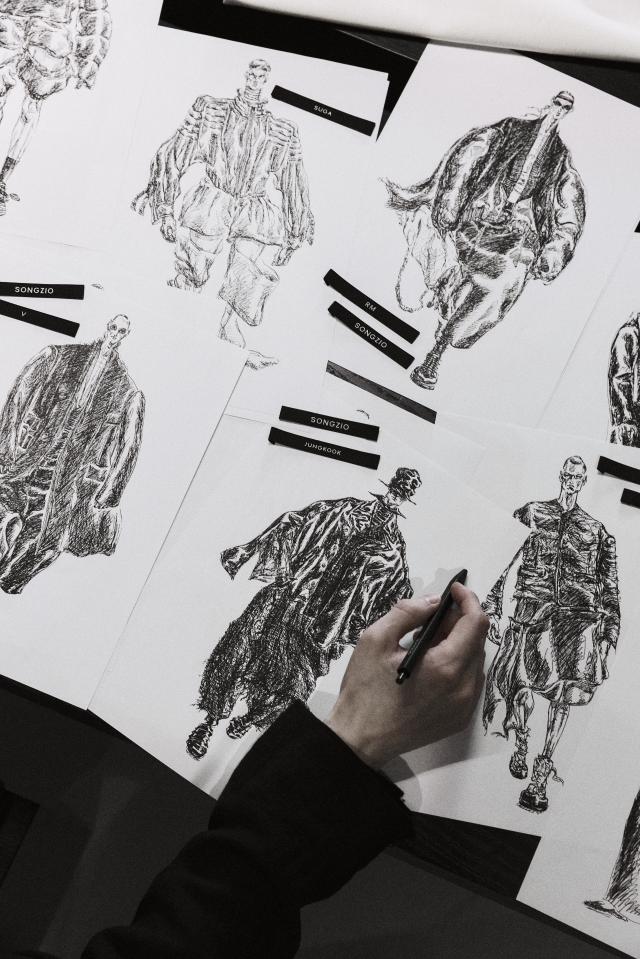
He also emphasized hand sketching over digital work. “A very subtle difference changes the result. The ‘hand feel’ in the process of making clothes matters,” he said.
His designs begin by hand, he said, but are completed on the person wearing them.
That approach, he said, naturally strengthened character-driven design. He said he was especially attached to V’s “doryeong” concept. “I focused on making each character’s narrative clearer,” he said. “It fits the brand’s direction well, with an image that has both strength and lyricism.”
For the stage, the team maximized visual impact through a black-and-white contrast, a choice meant to keep structural designs from appearing too heavy. Early concepts included detachable layering so changes could appear within a single look.
Song said the bolder incorporation of Korean elements helped relieve “a thirst I’d had to some extent,” and aligned closely with the “ARIRANG” concept.
Songzio said its aesthetics are completed in the tension between the avant-garde and elegance — structured yet flexible, tough yet lyrical.
The brand said it is preparing new expansions including a Disney collaboration, activewear, an “Oriental futurism” collection and a New York flagship. The New York store is being planned as an art space, beyond retail, in collaboration with Korean artists.
Songzio framed its work as more than making clothes: patience over haste, restraint over excess, and identity over trends.
At Gwanghwamun, the brand said, the outfits were not simply stage costumes, but a narrative completed on people.
* This article has been translated by AI.
Copyright ⓒ Aju Press All rights reserved.