

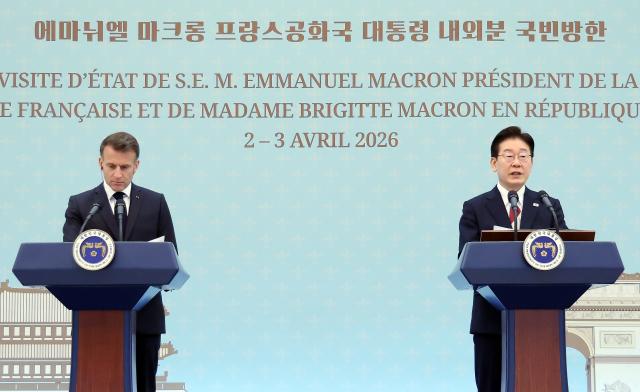
SEOUL, April 03 (AJP) -South Korean President Lee Jae Myung and French President Emmanuel Macron agreed Friday to strengthen cooperation in securing maritime shipping lanes in the Strait of Hormuz, as disruptions from the Middle East war continue to threaten global energy supply.
Speaking at a joint press statement following their summit at Cheong Wa Dae, Lee said the two leaders aligned on a coordinated response to the economic and energy fallout from the conflict.
“President Macron and I agreed to share policy experience and strategies to jointly respond to the economic and energy crisis caused by the Middle East war, and to work together to reduce global economic uncertainty,” Lee said.
The two sides also agreed to deepen cooperation in nuclear power and offshore wind to bolster energy security.
On trade, Lee noted that bilateral exchanges reached a record $15 billion last year but stressed the need to expand further. “We cannot be satisfied with that,” he said, setting a target of $20 billion by 2030.
He highlighted a $3.5 billion investment by French industrial gas company Air Liquide in South Korea last year and expressed hope that expanded investment in emerging industries would help double employment at firms with bilateral ties from about 40,000 to 80,000 over the next decade.
The summit produced 14 agreements spanning advanced industries and cultural cooperation.
Among them was a memorandum of understanding between Korea Hydro & Nuclear Power and French firms Orano and Framatome to strengthen cooperation in the global nuclear market and secure stable fuel supplies through closer integration of the nuclear fuel supply chain.
Additional agreements covered artificial intelligence, semiconductors and offshore wind. The two countries also revised their working holiday program to raise the eligible age to 18–35 from 18–30, alongside a letter of intent on language assistant exchanges and an MOU on cultural heritage cooperation.
Lee said the nuclear partnership would help ensure stable fuel supplies for South Korea while laying the groundwork for joint expansion into overseas nuclear projects.
On the Korean Peninsula, Lee said France — a permanent member of the U.N. Security Council — has consistently supported Seoul’s policy approach, adding that both leaders “deeply agreed” peace on the peninsula is critical to global stability.
He said he outlined South Korea’s efforts to resume inter-Korean dialogue and pursue peaceful coexistence, with Macron reaffirming France’s continued support for stability in the region.
Macron also formally invited Lee to attend the Group of Seven summit in June in Evian, France. Lee said he expects France, as G7 chair, to lead efforts to address global economic imbalances and reform international partnerships, adding that South Korea will play a constructive role.
Lee expressed hope for closer cooperation with France “for the next 140 years,” marking the long-standing bilateral relationship.
Copyright ⓒ Aju Press All rights reserved.
