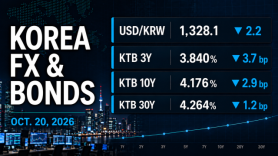
SEOUL, April 3 (AJP) — Spring has arrived, but South Korea’s debt market remains stuck in a winter chill, especially for sub-investment-grade issuers, as surging bond yields, weak demand and a cheapened won erode the appeal of Korean assets.
Government bond yields have climbed back to levels last seen in November 2023, when the benchmark rate stood at 3.50 percent during the post-pandemic tightening cycle — even as the current policy rate has been held at 2.50 percent for nearly a year.
The three-year government bond yield on Friday approached 3.5 percent, up more than 50 basis points this year, while the 10-year yield rose to around 3.8 percent, gaining over 60 basis points. The increase is roughly twice that of Japanese government bonds and more than triple the rise in U.S. 10-year Treasury yields, which have climbed about 15 basis points.
Some relief came as South Korean sovereign bonds began their inclusion in the World Government Bond Index (WGBI) on April 1, but yields quickly resumed their upward march as initial optimism faded.
The strain is more acute further down the credit curve.
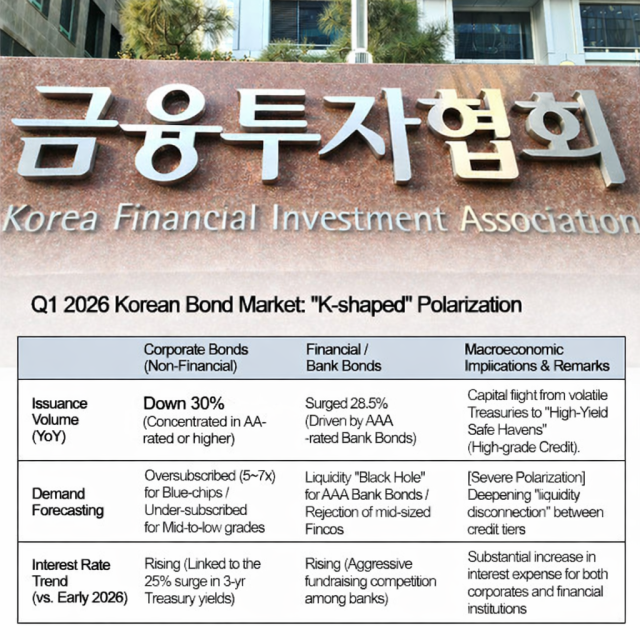
Corporate bond issuance totaled 21 trillion won ($14.2 billion) in the first quarter, down 30 percent from a year earlier, according to the Korea Financial Investment Association.
Yields on lower-rated debt have risen even faster. The three-year AA- yield has jumped more than 70 basis points to above 4 percent, while BBB- yields are nearing 10 percent.
Demand has narrowed sharply to top-tier borrowers. The share of demand for AA-rated corporate bonds rose to 93 percent in January 2026 from 81 percent a year earlier, underscoring an increasingly selective market.
Hanwha Aerospace, rated AA, drew 3.23 trillion won in bids for its Jan. 14 offering — nearly 13 times its initial 250 billion won target — prompting the company to double issuance to 500 billion won.
Similarly, AA- rated E-Mart attracted 1.94 trillion won in orders against a 300 billion won target. The retailer’s improved earnings outlook, including a 585 percent surge in operating profit in 2025, helped offset concerns over intensifying competition with Coupang.
The flight to quality is deepening refinancing pressure for lower-rated firms. Lotte Engineering & Construction (A) and CJ CGV (A-) have repeatedly withdrawn bond sales due to weak demand.
Geopolitical risks are compounding the stress. The ongoing disruption of the Strait of Hormuz — a critical artery for global energy flows — has driven up oil prices and dampened investor appetite for riskier credit.
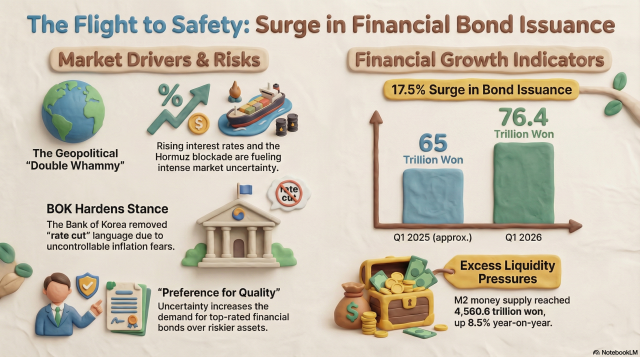
At the same time, financial institutions are ramping up issuance to shore up balance sheets against rising delinquencies. Financial bond issuance surged 17.5 percent on-year to 76.4 trillion won in the first quarter.
Liquidity remains ample but is adding to market distortions. Broad money (M2) reached 4,560.6 trillion won as of January, up 8.5 percent from a year earlier. Even under a narrower classification, it rose 5.8 percent to 4,108.9 trillion won — still outpacing major economies.
With excess liquidity weighing on the won and energy-driven inflation risks mounting, the Bank of Korea has already shifted its stance. It removed references to rate cuts from its January policy statement, even before the Middle East conflict escalated.

“As uncertainty grows, demand concentrates in top-rated bonds, including financial debt,” said Daeil Ahn, head of Korea debt capital markets at Citi.
Ultimately, both the surge in financial issuance and the concentration of demand reflect deepening market anxiety.
“The strengthening preference for safe assets is pushing flows into high-grade bonds,” said Kim Ki-myung, an analyst at Korea Investment & Securities, noting that the tilt toward AA-rated paper reflects heightened risk aversion.
Lee Jae-hyung, a researcher at Yuanta Securities, added: “The widening of credit spreads is a direct reflection of investors’ increasing risk-avoidance.”

Copyright ⓒ Aju Press All rights reserved.