T.S. Eliot once called April the cruelest month, for it forces life out of dead land. There is something unsettling about renewal. Beauty, when it returns too quickly, exposes what has been lost.
This April, the world stands once again before that line.
War is no longer a distant headline. In Iran and across the Middle East, conflict spills beyond borders, touching countries that once stood at the periphery.
In Ukraine, now in the fourth year of war, cities, power grids, hospitals and homes remain targets. War is not simply about territory. It is about the quiet dismantling of ordinary life — losing a home, losing a family member, wondering whether there will be electricity tonight or fuel to cook tomorrow.
The numbers tell the story with cold precision. According to the United Nations Human Rights Monitoring Mission in Ukraine, 2,514 civilians were killed and 12,142 injured in 2025 alone — a 31 percent increase from the previous year.
Long-range weapons and drone strikes have expanded the battlefield into entire cities. Civilian infrastructure is no longer collateral damage; it is the target. On April 3, another wave of Russian strikes killed civilians and destroyed residential and administrative buildings. Even a veterinary hospital near Kyiv was hit, killing dozens of animals. War does not stop at human life; it erodes the entire fabric of living systems.
In the Middle East, even the numbers resist clarity. That, too, is part of the story. Reuters’ March 31 compilation shows at least 1,368 deaths in Lebanon and 19 in Israel, with additional casualties reported across Iraq, Kuwait, Bahrain, Oman, Saudi Arabia and the United Arab Emirates.
Iran’s toll is more uncertain. The International Federation of Red Cross and Red Crescent Societies estimates over 1,900 dead and around 20,000 injured. A U.S.-based rights group, HRANA, places the figure closer to 3,500.
When numbers diverge this widely, it does not suggest fewer deaths — it suggests a war that cannot be fully counted.
South Korea, for now, remains outside the direct line of fire. There are discussions of emergency fiscal spending, vehicle rationing and energy contingency measures. Northeast Asia is not under bombardment. But distance does not equal detachment. The shock travels through other channels — oil prices, exchange rates, inflation and supply chains.
The Middle East crisis is, in many ways, an Asian crisis. According to the U.S. Energy Information Administration, 84 percent of crude oil and condensate and 83 percent of liquefied natural gas passing through the Strait of Hormuz in 2024 were bound for Asia.
Roughly one-fifth of global LNG trade flows through that narrow passage. When Hormuz falters, the effects do not remain at sea. They ripple outward — into fuel prices in Seoul, fertilizer costs in Southeast Asia and power shortages in South Asia. The strait is not just a geographic chokepoint. It is a lifeline.
This is not merely an oil price spike. Across Southeast Asia, governments are already deploying familiar emergency measures — expanding fuel subsidies, cutting budgets, adjusting fuel standards, shifting energy sources. The sequence is recognizable.
First comes the energy shock. Then inflation spreads through transportation, electricity and agriculture. Governments intervene to cushion the blow, straining public finances. Eventually, the pressure reaches food systems and social stability. This pattern has repeated itself before — in the oil shocks of the 1970s, the Asian financial crisis of 1997, the food crisis of 2007–08. There is little reason to assume this time will be different.
When fuel becomes scarce, what breaks first is not strategy but routine. Bus schedules falter. Fishing boats stay docked. Refrigerated logistics grow more expensive. Fertilizer prices rise, pushing up the cost of food. What appears in headlines as an “energy crisis” manifests in daily life as skipped meals, lost wages and mounting uncertainty. War travels. It does not respect distance.
And yet, in the midst of this brutal spring, there is another image.
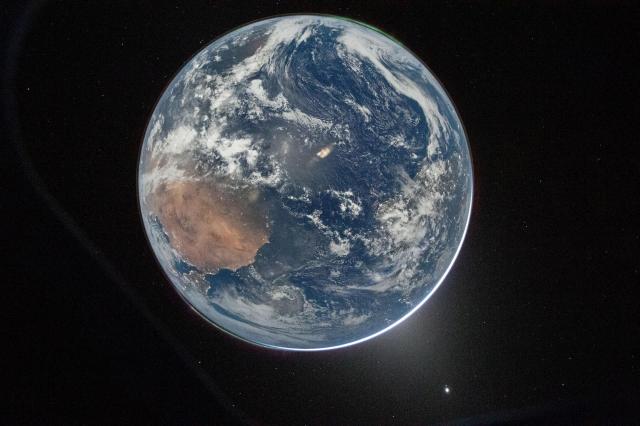
On April 3, astronauts aboard NASA’s Artemis II mission released the first images of Earth taken from beyond its orbit. The photographs show a blue sphere edged with auroras, with faint zodiacal light glowing as the Earth eclipses the Sun. Commander Reid Wiseman described seeing the planet from pole to pole.
Astronaut Victor Glover offered a simple message: “You are beautiful.” From that vantage point, humanity appears as a single presence — without borders, without divisions, without the language of conflict.
Seen from space, the Earth is whole.

Seen from the ground, the sky is beautiful too. This weekend, cherry blossoms scatter in the spring wind, falling like pale snow. This year they bloomed early and faded quickly, not lasting even a full week at their peak. We often say that flowers are beautiful because they are fleeting. But there is something uneasy about how quickly they vanish. The brevity of the bloom mirrors a deeper fragility — of peace, of stability, of the ordinary rhythms we assume will endure.
So April must be seen through two lenses.
One is the distant view, from above, where humanity appears unified, where the lines we draw seem temporary and small.
The other is the grounded view, from beneath the blossoms, where life is lived day by day — where a meal, a home, a night’s sleep are not abstractions but necessities. War, in the end, is not geopolitics. It is the erosion of these small certainties.
April is cruel.
In Iran, in Ukraine, and across parts of Asia absorbing the shock of energy and food disruption, people lose homes, families and the ability to sustain daily life. South Korea is not at the center of this destruction. But it is not outside it either. We inhabit the same planet.
What this moment demands is not only awareness of beauty, nor only attention to statistics, but the capacity to hold both at once — to recognize the elegance of the Earth from afar while refusing to ignore the devastation unfolding upon it.
The Earth, seen from space, is beautiful. The sky, seen beneath the blossoms, is beautiful.
And still, April remains the cruelest month.
*The author is the managing editor of AJP
Copyright ⓒ Aju Press All rights reserved.