

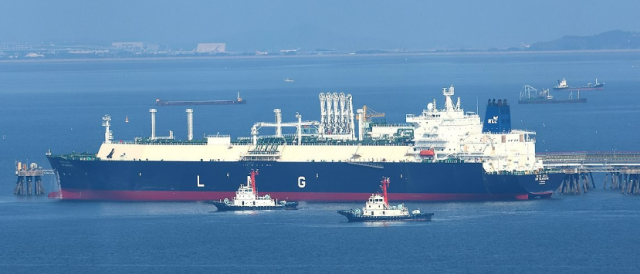
SEOUL, April 06 (AJP) -South Korea’s liquefied natural gas supply chain faces a fresh hit as Australia — an increasingly critical supplier amid Middle East disruptions — signals possible export curbs to prioritize domestic demand. warning comes as Seoul leans more heavily on Australian LNG to offset heightened risks stemming from the Middle East war.
Despite government reassurance of stable supply, industry officials caution that tightening export controls by major producers could quickly ripple through global supply chains, posing risks for import-dependent economies such as Korea.
Non-state entities like SK Innovation E&S and Posco International have been expanding upstream investments and diversifying sourcing strategies, helping to provide critical hedges against geopolitical shocks.
SK Innovation E&S has begun direct imports of LNG from Australia’s Barossa gas field this year, establishing a long-term supply base. The project marks the first time a South Korean private company has independently carried out the full value chain — from exploration participation to development, production and import.
The company invested 1.6 trillion won to secure 1.3 million tons of LNG annually over 20 years, equivalent to about 3 percent of South Korea’s yearly imports, providing a measure of stability amid growing uncertainty.
Posco International is pursuing a parallel strategy centered on North America. In 2024, it signed 20-year contracts totaling 1.1 million tons per year — 700,000 tons with Mexico Pacific and 400,000 tons with U.S.-based Cheniere Energy.
Starting in the second half of this year, the company plans to bring North American LNG into South Korea using an LNG-dedicated vessel secured through Cheniere, effectively building its own logistics channel.
Beyond procurement, Posco International is also strengthening its upstream footprint. It invested 926 billion won in 2024 for phase four development of a Myanmar gas field, where about 80 percent of output is sold to China.
In Australia, Senex Energy — acquired by Posco International in 2022 for about 400 billion won — has recently raised production to around 1.2 million tons annually, with most volumes supplied to eastern Australia.
These diversification efforts are gradually reshaping South Korea’s LNG import structure. Of the country’s roughly 45 million tons of annual LNG imports, about 70 percent is handled by state-run Korea Gas Corp., while private companies account for the remaining 30 percent, largely for their own power generation needs.
Reliance on a single state buyer, as in the past, would have left South Korea more exposed to export restrictions or supply disruptions from specific countries.
“LNG demand is concentrated in Asia, and for a country like South Korea that relies heavily on imports, diversifying supply chains is essential,” an industry official said. “Preemptive investment by private companies and expanded direct imports are becoming even more important in a crisis.”
Copyright ⓒ Aju Press All rights reserved.
