

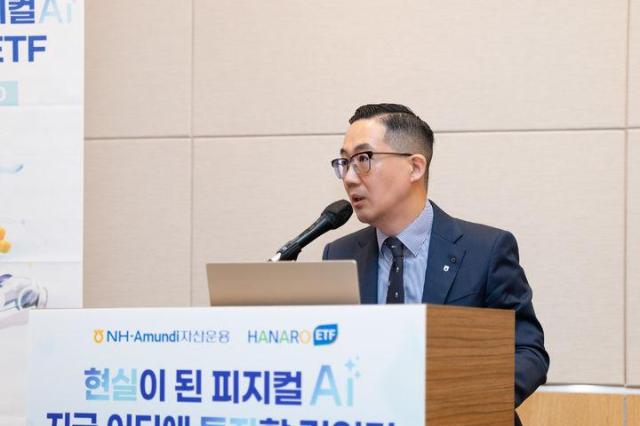
NH-Amundi Asset Management, which launched what it described as South Korea’s first active exchange-traded fund focused on physical artificial intelligence, on Tuesday laid out its investment strategy for the physical AI era. The firm said companies that use AI effectively are likely to be bigger beneficiaries than those that primarily build AI, and it presented themes spanning the AI value chain, including energy, optical communications infrastructure and semiconductors.
The company held a “Physical AI Investment Strategy” briefing in Seoul’s Yeouido district and named five themes to watch in the physical AI value chain: energy, optical communications infrastructure, semiconductors, AI models and applications.
“Physical AI doesn’t take a single form. Humanoids and autonomous driving are only the beginning,” said Choi Dong-geun, head of the firm’s ETF management team. He said physical AI is already spreading into advanced manufacturing processes, intelligent logistics systems, automated ports and precision surgical robots, changing how industries operate, including agriculture and health care. “The imperfections of the real world created by humans are, in fact, an opportunity for AI,” he added.
Choi said market leadership in the AI investment cycle has shifted in sequence from GPUs to power, high-bandwidth memory, storage and optical communications infrastructure, and he stressed the importance of identifying companies that can relieve the next bottleneck.
In energy, he pointed to surging electricity demand from AI computing. “The most expensive part of implementing AI is electricity,” Choi said, adding that the ability to secure power supply and energy infrastructure is becoming a competitive advantage.
He said optical communications infrastructure is emerging as a key way to ease data bottlenecks. As inference-based AI services expand and data volumes jump, network bandwidth is becoming a new constraint, he said, arguing that optical networks that can replace the limits of copper-based systems could lead the next supercycle.
Choi said semiconductors should remain attractive as benefits spread beyond memory to central processing units, analog chips and power semiconductors, while hyperscalers continue to increase capital spending. He also cited Nvidia’s next-generation AI platform adopting a high-voltage direct-connection approach as another reason the importance of power semiconductors is rising.
He also highlighted AI models and applications, saying AI is evolving from simple question-and-answer tools into agents that can judge and act, increasing the value of companies that apply AI in real workplaces to lift productivity and profitability.
In applications, Choi said traditional manufacturers could be re-rated. He said industrial companies with strong capabilities in hydraulics, bearings, fuel control and precision control could be reborn as key component suppliers in the physical AI era. He urged investors to focus on “AI hyper-adopters” that make AI a core business tool and significantly improve profitability.
The briefing also highlighted performance of the firm’s “HANARO Global Physical AI Active ETF.” As of April 20, about a year after listing, it had returned more than 127%, outperforming the Nasdaq 100 by about 78 percentage points over the same period.
Kwon Yong-min, head of the ETF Product Research Team, said the fund initially searched for beneficiaries across five areas — infrastructure, robots, autonomous driving, edge AI and applications — and later increased exposure after identifying network speed and cost-efficient AI infrastructure sectors early. He said the performance gap widened in the second half as the fund added memory semiconductors, optical communications infrastructure and beneficiaries in traditional industries.
* This article has been translated by AI.
Copyright ⓒ Aju Press All rights reserved.