

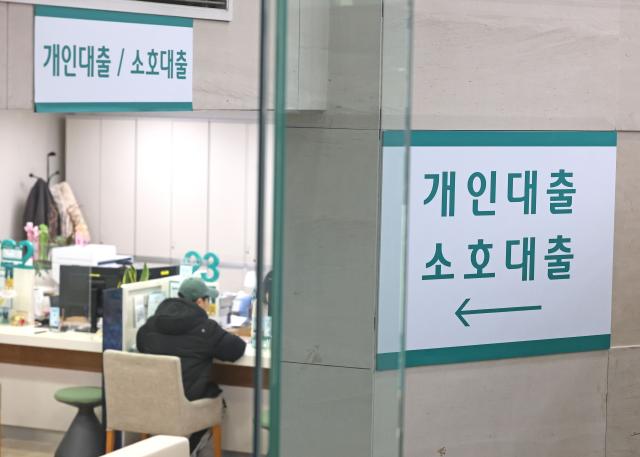
Banks have increased corporate lending in the name of expanding “productive finance,” but critics say the money is flowing more to top-rated borrowers than to innovative firms and small merchants. That helps explain why, despite announcements of trillion-won support packages, many businesses say the impact on the ground remains limited.
According to the financial sector on Tuesday, KB Kookmin, Hana, Woori and IBK Industrial Bank of Korea have contributed a combined 36.5 billion won to the Korea Credit Guarantee Fund so far this year. The total includes 30.5 billion won in special contributions and 6.0 billion won in support for guarantee fees. Including those banks, seven lenders have contributed 67.2 billion won to support non-capital regions.
When banks make special contributions to policy guarantee institutions such as the Korea Credit Guarantee Fund and the Korea Technology Finance Corp., the agencies use the money to issue partnership guarantees. Banks then lend to small and midsize companies using those guarantees as collateral. The industry typically estimates the contributions can generate lending equal to 20 to 100 times the amount, meaning a 100 billion won contribution can translate into several trillion won in financing.
The concern is that public institutions effectively take on the credit risk. If a guaranteed loan turns sour, banks face limited losses because the guarantee agency repays the debt, allowing banks to recover up to 90% to 100% of principal. That lets banks expand loan assets without a comparable hit to their soundness ratios.
Supporters say the guarantees can serve as seed money for productive finance by helping lower-credit firms raise working capital and funds for facilities. But the burden on guarantee agencies inevitably grows as they absorb more risk.
Subrogation payments by guarantee institutions have been rising. As of March, the number of troubled companies that received guarantees from the Korea Credit Guarantee Fund, the Korea Technology Finance Corp. and regional credit guarantee foundations, then failed to repay bank loans on time, jumped to 13,851 — 2.8 times the previous month’s 4,907. Subrogation payments tied to those cases totaled 594.8 billion won, up more than 40 billion won in a month.
Meanwhile, loans that banks extend while directly bearing the risk have largely gone to stronger borrowers. As of the end of March, outstanding large-company loans at the five major banks — KB Kookmin, Shinhan, Hana, Woori and NH NongHyup Bank — stood at 179.0119 trillion won, up 5.12% from the end of last year. Over the same period, outstanding loans to small and midsize companies rose just 0.94% to 680.7618 trillion won. The figures suggest that while productive finance is billed as support for innovative firms, venture companies and small businesses, much of the money is still flowing to creditworthy conglomerates.
One reason is that formal-sector finance remains difficult for vulnerable borrowers. Of loans to small merchants and self-employed borrowers, 79.8% are secured loans and 10.6% are loans with guarantors, while unsecured credit loans account for only 9.6%.
A financial industry official said the sector agrees with the goal of expanding productive finance, but added that “to maintain soundness regulations, funds inevitably concentrate in relatively safe borrowers.” The official said improving productive finance in line with its stated purpose will require “qualitative improvements through a risk-sharing structure and better allocation of funds.”
* This article has been translated by AI.
Copyright ⓒ Aju Press All rights reserved.