

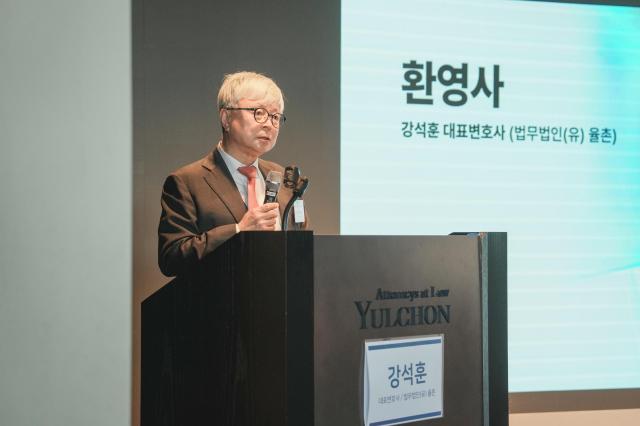
Yulchon LLC, the OnYul public-interest foundation and the Social Value Institute held the third Yulchon-OnYul Public Interest Legal System Conference at 2 p.m. April 21 at Yulchon’s lecture hall in Seoul’s Gangnam district.
The three organizations have hosted an annual conference since 2024, selecting topics aimed at improving public-interest legal frameworks. This year’s agenda focused on legal and legislative issues surrounding the permit-based system for establishing nonprofit corporations, legislative tasks to improve nonprofit governance, and ways to expand and institutionalize the measurement and compensation of social value.
The event opened with remarks from the heads of the co-hosting organizations. Lee In-yong, co-chair of OnYul, said it has become difficult to ignore criticism that laws and institutions are acting as barriers rather than safeguards for people seeking to engage in public-interest work. He said he hoped the discussions would help spur legal and legislative improvements.
Kang Seok-hoon, managing partner at Yulchon, said the public-interest ecosystem has been unable to fully exercise autonomy and creativity under an outdated legal system and excessive regulation that has been in place for more than half a century. He said Yulchon and OnYul would work together as partners in reform.
Na Seok-kwon, head of the Social Value Institute, cited a remark attributed to Michelangelo about freeing an angel from marble while creating the statue of David. He said he hoped the conference would help chip away at entrenched practices and rigid interpretations to enable major achievements in solving social problems.
Discussions then continued in three sessions.
In the first session, on legal issues and legislative tasks related to the permit system for establishing nonprofit corporations, Lee Dong-jin, a professor at Seoul National University School of Law, presented arguments that the permit requirement under Article 32 of the Civil Act is unconstitutional. Attorney Lee Hee-sook of the Dongcheon Foundation presented legislative alternatives centered on creating a public-interest commission.
Lee Dong-jin cited the Constitution’s Article 21(2), which explicitly bans prior permission for associations, and noted that major countries including Germany, France and Japan have already shifted to a rules-based system. Lee Hee-sook said reform should go beyond simply abolishing the permit system, proposing a new legal framework that would establish a public-interest commission to integrate authorization, support and oversight of public-interest corporations. The session followed a December ruling in which the Seoul Administrative Court referred a constitutional review of Article 32 to the Constitutional Court (2025Hun-Ga20).
A panel discussion, moderated by Yulchon attorney Yoon Yong-seop, included Kim Deok-san, chairman of the Korea Public Interest Corporation Association; attorney Jeong Soon-moon of The Ham Law Firm; OnYul attorney Jeon Gyu-hae; and Kim Da-hye, a senior official in the Justice Ministry’s Legal Review Office. Panelists raised concerns about the permit system and exchanged views from their respective positions.
The second session addressed legislative tasks to improve nonprofit governance. Bae Won-gi, head of the Nonprofit Organization Evaluation Institute, introduced overseas governance systems, including the U.S. intermediate sanctions regime, the U.K. Charity Commission model, and Japan’s requirement for councils for foundation corporations, and discussed directions for improving Korea’s system.
Kim Jeong-yeon, a professor at Ewha Womans University School of Law, outlined limits in current nonprofit regulation and public oversight tools. She presented tasks for rebuilding legal models, including codifying directors’ duty of loyalty, introducing shareholder-style derivative suits, and revising the Public Interest Corporation Act.
A discussion moderated by Lim Seong-taek, a director of the Duru foundation, featured Baek Dong-ho of Korea GuideStar; Park Dong-soon of the Korea YWCA; Yoon Hwan-cheol of the Mirae Nanum Foundation; and Kim Hyun-joo of the social welfare corporation Together Walking Children, who discussed governance improvements from the field perspective.
The third session took the form of a talk concert on expanding and institutionalizing social value measurement and compensation. It was moderated by Jeong Myeong-eun of the Social Value Institute, with panelists Yoo Mi-hyun of the institute; Kim Young-sik, secretary general of the National Council of Local Governments for Social Solidarity Economy; Kwak Je-hoon, CEO of Pan-Impact Korea; and attorney Lee Seon-min of Duksu Law Firm.
The panel reviewed the legislative progress and significance of the Framework Act on Social Solidarity Economy, which was expected to pass the plenary session, and assessed the past decade of performance-based support models, including Social Impact Bonds (SIB) and Social Performance Compensation (SPC).
Yoo said the Social Performance Compensation program has, since 2015, paid 76.9 billion won in incentives in proportion to 536.4 billion won in social performance created by 468 companies, and that it has led to policy shifts by local governments including Hwaseong.
Kwak cited an SIB case supporting children with borderline intellectual functioning, arguing that innovations difficult under process-focused administration can be achieved through performance-based approaches.
Kim Young-sik said some activities that address social problems are inherently difficult to measure, and argued against treating performance-based support and grant funding as a strict either-or choice, calling instead for diversification depending on circumstances.
Lee Seon-min pointed to issues that must be resolved in legislation, including the objectivity of social value measurement, who bears measurement costs, and how to ensure fairness.
Yulchon, OnYul and the Social Value Institute said they plan to continue related work so that the conference discussions can lead to a legislative roadmap in preparation for a possible unconstitutional ruling on the nonprofit permit system, institutional changes to improve public-interest corporation governance, and the institutionalization of social value measurement after enactment of the Framework Act on Social Solidarity Economy.
* This article has been translated by AI.
Copyright ⓒ Aju Press All rights reserved.