

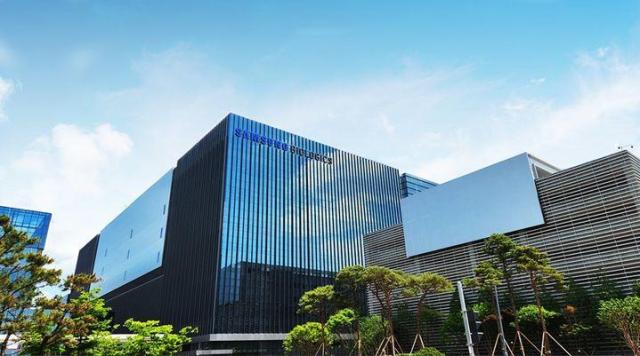
Samsung Biologics said it extended its growth streak in the first quarter, starting the year strongly as it targets annual revenue of 5 trillion won.
The company reported first-quarter revenue of 1.2571 trillion won and operating profit of 580.8 billion won, it said in a regulatory filing on the 22nd. Revenue rose 25.8% from a year earlier and operating profit increased 35%.
Samsung Biologics maintained its full-year revenue growth guidance of 15% to 20%, citing full utilization at Plants 1 through 4 and a ramp-up at Plant 5. The outlook, first presented in January, does not include any revenue contribution from its acquisition of a manufacturing site in Rockville, Maryland. The company said it plans to provide updated guidance reflecting that deal later.
As of the end of the first quarter of 2026, Samsung Biologics reported assets of 11.9950 trillion won, equity of 7.9228 trillion won and liabilities of 4.0722 trillion won. It said its balance sheet remained stable, with a debt-to-equity ratio of 51.4% and a borrowing ratio of 11.6%.
The company also reported steady order activity across contract manufacturing (CMO) and contract development (CDO). Cumulative orders since its founding totaled 112 CMO deals and 169 CDO deals, with cumulative contract value reaching $21.4 billion, it said.
Samsung Biologics said it is expanding global production capacity. It completed the acquisition of the Rockville facility at the end of March, securing local staff and infrastructure and building a continuous production system. It said it is also strengthening order competitiveness through closer coordination with global drugmakers.
The company said it has enhanced its service portfolio by bringing master cell bank production and vector construction in-house, enabling an end-to-end service that can move from vector build to an IND submission within nine months. It also said it secured flexible production capacity through the CEPI network to improve its ability to respond to global public health crises.
Despite the strong results, labor risk was cited as a potential burden. The Samsung Biologics Mutual Growth Labor Union held a rally on the 22nd and stepped up pressure in wage and collective bargaining talks. Labor and management have held 13 rounds of negotiations since December but have not reached an agreement. The union said it plans a large-scale strike on May 1 if differences are not narrowed.
Market participants have raised concerns that a strike could disrupt production and increase earnings volatility. Samsung Biologics posted 2025 revenue of 4.5570 trillion won, up 30.3% from a year earlier, and has set a 2026 revenue target of 5.3200 trillion won.
A bio industry official said, "If the union goes ahead with a strike, disruptions to the May production schedule are unavoidable," adding, "We cannot rule out penalties for contract violations with global clients and potential damage to trust."
Samsung Biologics maintained its full-year revenue growth guidance of 15% to 20%, citing full utilization at Plants 1 through 4 and a ramp-up at Plant 5. The outlook, first presented in January, does not include any revenue contribution from its acquisition of a manufacturing site in Rockville, Maryland. The company said it plans to provide updated guidance reflecting that deal later.
As of the end of the first quarter of 2026, Samsung Biologics reported assets of 11.9950 trillion won, equity of 7.9228 trillion won and liabilities of 4.0722 trillion won. It said its balance sheet remained stable, with a debt-to-equity ratio of 51.4% and a borrowing ratio of 11.6%.
The company also reported steady order activity across contract manufacturing (CMO) and contract development (CDO). Cumulative orders since its founding totaled 112 CMO deals and 169 CDO deals, with cumulative contract value reaching $21.4 billion, it said.
Samsung Biologics said it is expanding global production capacity. It completed the acquisition of the Rockville facility at the end of March, securing local staff and infrastructure and building a continuous production system. It said it is also strengthening order competitiveness through closer coordination with global drugmakers.
The company said it has enhanced its service portfolio by bringing master cell bank production and vector construction in-house, enabling an end-to-end service that can move from vector build to an IND submission within nine months. It also said it secured flexible production capacity through the CEPI network to improve its ability to respond to global public health crises.
Despite the strong results, labor risk was cited as a potential burden. The Samsung Biologics Mutual Growth Labor Union held a rally on the 22nd and stepped up pressure in wage and collective bargaining talks. Labor and management have held 13 rounds of negotiations since December but have not reached an agreement. The union said it plans a large-scale strike on May 1 if differences are not narrowed.
Market participants have raised concerns that a strike could disrupt production and increase earnings volatility. Samsung Biologics posted 2025 revenue of 4.5570 trillion won, up 30.3% from a year earlier, and has set a 2026 revenue target of 5.3200 trillion won.
A bio industry official said, "If the union goes ahead with a strike, disruptions to the May production schedule are unavoidable," adding, "We cannot rule out penalties for contract violations with global clients and potential damage to trust."
* This article has been translated by AI.
Copyright ⓒ Aju Press All rights reserved.