

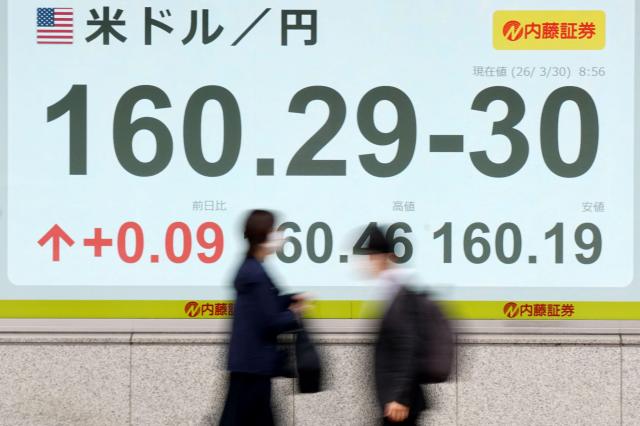
With the Bank of Japan’s rate hike effectively pushed back to June, market participants are warning that Iran-related energy price swings could drive the yen’s weakness into a new phase. Analysts say yen selling led by corporate demand — rather than speculative money — is harder for policymakers to counter, raising the risk of a prolonged weak-yen cycle.
Nikkei reported on April 22 that more investors are now talking about a “second wave” of yen weakness in the second half of this year. It said the yen has recently traded in a narrow band of 158 to 160 per dollar largely because hedge funds and other speculative players are making short-term trades while watching for possible Japanese government intervention, limiting day-to-day volatility.
Nikkei said the bigger risk lies in what comes next. If oil prices that surged amid the Iran situation settle and crude imports normalize, demand for dollars to pay for energy imports could rise again, intensifying yen selling.
It noted that military clashes have damaged parts of oil refining facilities in the Middle East and that tensions around the Strait of Hormuz persist, meaning a risk premium could remain embedded in shipping costs for some time. Takahide Kiuchi, an economist at Nomura Research Institute, said it could take several months to half a year for oil prices to stabilize.
That shift could change the nature of the yen’s decline. Speculative yen selling is often followed by yen buying to lock in profits, but yen selling tied to real demand — such as import payments — is less likely to be reversed later. Nikkei said if real-demand selling expands, there may be few forces to pull the exchange rate back, increasing the odds of a long-lasting weak yen.
Policy options are also limited. Authorities can more easily seek understanding from the United States and others for intervention against speculative moves, but it is difficult to suppress exchange-rate shifts driven by corporate activity. Koji Fukaya, head of Market Risk Advisory, said, “It is hard to predict where the Iran situation is headed, but a scenario in which the yen-dollar rate breaks above 160 yen is entirely possible.”
Nikkei said real-demand selling could also deepen pressure through the trade balance. Many foreign-exchange market sources expect a large trade deficit this year, it reported. More than half projected a deficit of 5 trillion to 15 trillion yen (about 46 trillion to 139 trillion won), and not a few forecast it could reach 20 trillion yen. In 2022, when the trade deficit swelled to 20 trillion yen amid a surge in resource prices after Russia’s invasion of Ukraine, the yen weakened from the 115-per-dollar range early in the year to 150.
Concerns about a prolonged weak yen also matter for South Korea. A cheaper yen can boost the price competitiveness of Japanese exporters, increasing pressure on South Korean firms in sectors where they compete directly in global markets, including semiconductors, automobiles and steel. It could also lift demand for travel to Japan while shifting some domestic spending overseas. South Korea, which relies heavily on energy and raw-material imports, is also directly exposed to higher global oil prices.
* This article has been translated by AI.
Copyright ⓒ Aju Press All rights reserved.