

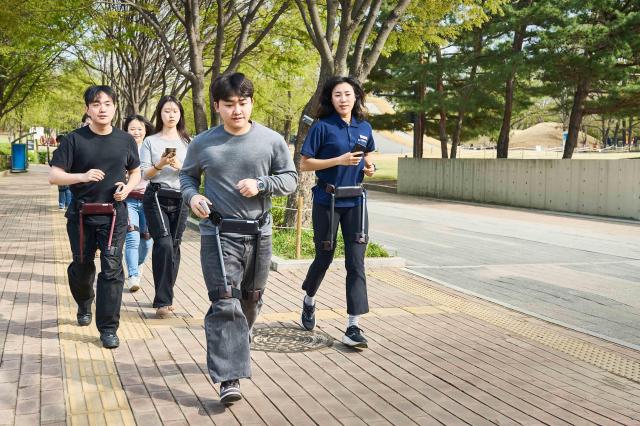
#At a WIM walking exercise center in Songpa-gu, Seoul, a reporter strapped on a waist belt connected to leg supports and headed toward Olympic Park outside the facility. After pressing “Air Mode” and taking a few slow steps, the device felt as if it gently nudged the body forward. Within several steps, walking became easier, and when the pace increased slightly, the stride rhythm stayed steady. On an uphill section, switching to “Hiking Mode” made climbing feel more comfortable. Rather than a heavy machine, it was a 1.6-kilogram wearable that moved with the user’s gait.
The reporter took part on April 13 in a hands-on event marking WIRobotics’ launch of “WIM Premium,” a subscription service based on its WIM S wearable walking-assist robot. Instead of a one-time purchase, the company said it will keep updating functions to match a user’s walking data and condition, similar to smartphone operating system updates.
WIM Premium offers three subscription modes: △Balance (left-right) △Soft △Slow Jogging.
The most notable feature was “Balance Mode,” which analyzes differences between left and right steps and applies different levels of assistance. With stronger support on one leg, the effect was clear. The company expects it to help users who put more weight on one side during long walks or whose gait balance has deteriorated.
In “Soft Mode,” the focus shifts to reducing impact when the foot hits the ground. Even with a longer stride, the burden on knees and ankles felt lower. The company said the mode is suited for long walks, light trekking and middle-aged users who feel joint strain.
“Slow Jogging Mode” is designed to help users keep a steady rhythm without running fast. In the demonstration, a natural tempo between walking and running was maintained. It may appeal to office workers and older adults who want more exercise but find running hard on the knees and joints.
While earlier wearable robots were centered on rehabilitation therapy or industrial sites, WIRobotics is aiming this service at everyday consumers. Existing users can access new functions through software updates by paying a monthly subscription fee, without replacing the device. The company is positioning the robot less as something to buy and more as functions to use.
The company is also betting on demand as South Korea ages rapidly and interest grows in extending healthy life expectancy and home training. With rising attention to senior health care such as maintaining walking ability and supporting muscle strength, the market for daily-use wearable robots could expand. Potential settings include rehabilitation centers, senior living communities and fitness centers.
Barriers remain. Wearable robots are still unfamiliar to many consumers, and purchase prices can run into several million won. Wearing a device to walk may also feel unnatural.
Still, based on the hands-on test, WIM Premium appeared likely to find demand among seniors who need walking assistance, evolving toward a personalized mobility aid that adapts to walking habits and physical condition.

WIRobotics said it will continue upgrading functions using user walking data and plans to expand applications beyond daily walking assistance to rehabilitation exercise, outdoor activity and support for workers in industrial settings.
Lee Yeon-baek, WIRobotics’ co-CEO, said everyday movement such as walking varies widely by individual, making it difficult for a single piece of hardware to meet every user’s needs. “WIM Premium is the starting point of a robotics-as-a-service (RaaS) model that continuously improves assistance methods based on user data,” he said.
He added that wearable robots will develop into integrated services that include devices and software, updates and maintenance.
* This article has been translated by AI.
Copyright ⓒ Aju Press All rights reserved.