

Mohamed Zamruni bin Khalid, Malaysia’s ambassador to South Korea, said in an interview Tuesday with Ajou Economy and AJP that “energy security is the starting point for strategic cooperation between our two countries.” He said Malaysia’s liquefied natural gas supply capacity, paired with South Korea’s industrial competitiveness in energy use, could create “an interdependent but complementary structure.”
He pointed to carbon capture, utilization and storage, or CCUS, as the most practical area for near-term cooperation. “A representative model we can pursue immediately is storing carbon dioxide captured in Korea in Malaysia’s depleted reservoirs,” he said, adding that a cross-border carbon value chain could be built.
The proposal comes as Asia’s energy vulnerability has been exposed after the Strait of Hormuz was effectively blocked following a war in the Middle East. With the strait — through which more than 20% of global oil and LNG cargo volumes pass — shut, the need to diversify regional sourcing has surged.
Shifts are also being seen in South Korea’s import mix. Last year, Australia accounted for the largest share of South Korea’s LNG imports at 31.4%, followed by Malaysia at 16.1% and Qatar at 14.9%. For crude oil, imports from Malaysia jumped 140% in March from a year earlier, while imports from seven Middle Eastern countries fell 18.3%, according to the Korea International Trade Association. As a result, the Middle East share declined to 62.9% from 73%.
Malaysia, which has proven reserves of about 2.7 billion barrels, is emerging as an alternative energy supplier that could help spread geopolitical risk, beyond its role as an LNG provider.
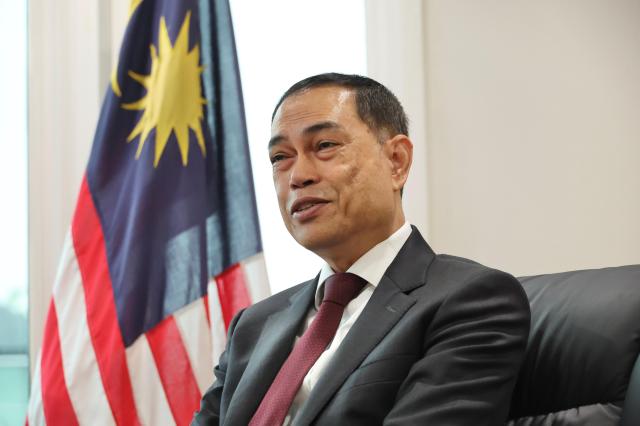
Khalid said bilateral ties already rest on a broad base centered on supply chains, semiconductors and energy security, and could evolve into a more strategic relationship if cooperation expands into the economy, technology and defense industries.
Two-way trade totaled about $27.4 billion in 2025, staying above $20 billion for several years. “It is a meaningful achievement that it has already exceeded $20 billion in the early stage of the partnership,” he said.
Malaysia’s industrial strategy is also widening points of contact with South Korea. Through the New Industrial Master Plan 2030, the government has set advanced manufacturing, digital transformation, smart factories and a transition to cleaner energy as key growth pillars.
In semiconductors, Malaysia is increasing its presence in global supply chains. The Ministry of Investment, Trade and Industry and the Malaysian Investment Development Authority said Malaysia accounts for about 13% of the global market for semiconductor assembly, testing and packaging, and ranks sixth in exports.
Khalid said the strategy aligns with South Korea’s strengths, naming advanced semiconductor manufacturing, digital transformation, smart manufacturing and clean energy as core areas for cooperation. He also cited electric vehicle batteries, green hydrogen, CCUS, medical devices, automation, e-commerce, fintech and artificial intelligence as promising fields.
He said the approach combines South Korea’s technological maturity with Malaysia’s net-zero goals and resource availability, creating momentum for both countries to move into higher value-added industries.
On CCUS, he said Malaysia emphasizes “utilization,” distinguishing it from South Korea’s focus on carbon capture and storage, or CCS. “Because we link utilization with storage, the ‘U’ is important,” he said.
Malaysia has also moved quickly to build a policy framework, recently passing a CCUS law and establishing a dedicated agency to set regulations covering capture, transport and permanent storage. The steps are expected to expand opportunities for South Korean companies.
Petronas, Malaysia’s state energy company, is the main channel for cooperation, with South Korean firms including Samsung Engineering and the Korea National Oil Corp. participating.
Khalid said the cooperation offers South Korean companies a chance to take part both as technology suppliers and as demanders of low-carbon fuels, and could contribute over the long term to securing energy supply chains linked to South Korea’s hydrogen economy.
He also said there is room to expand cooperation in tourism and the halal industry. More than 300,000 Malaysian tourists visited South Korea last year. He said access should be improved not only to prayer rooms but also to washing facilities for wudu, the ritual cleansing performed before prayer, and that cooperation is possible in halal industries spanning food, cosmetics and tourism.
Malaysia attracted more than 25 million foreign tourists last year and is promoting its “Visit Malaysia 2026” campaign. Khalid said the multicultural appeal highlighted by the “Malaysia Truly Asia” slogan could also be competitive in drawing South Korean visitors.
Cultural exchanges linked to the Korean Wave are also expanding. According to a 2025 survey by the Korea Foundation for International Cultural Exchange, 70.2% of respondents in Malaysia said their perception of South Korea improved after exposure to Korean cultural content.
Khalid, a career diplomat who previously served as ambassador to France, took up his post in South Korea in 2024. “The past two years in Seoul have been a very enjoyable experience,” he said, expressing expectations for broader cooperation.
* This article has been translated by AI.

Copyright ⓒ Aju Press All rights reserved.