

“Recent housing supply in South Korea is showing a gap between expectations for expanded supply and the reality, amid domestic and global economic uncertainty and growing management burdens in the construction industry.”
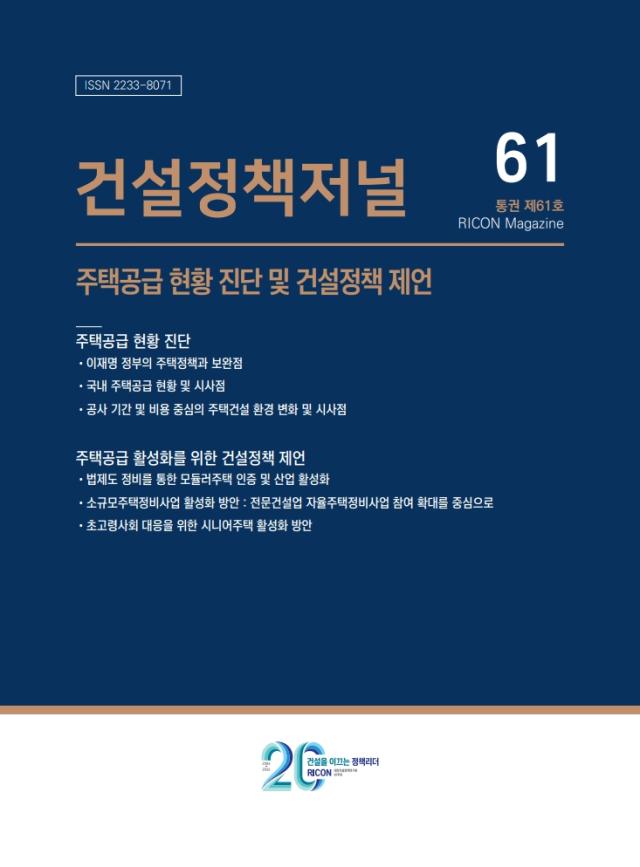
The Korea Construction Policy Institute said that in Construction Policy Journal No. 61, published on the 23rd, which addresses structural problems in domestic housing supply and policy response directions.
The issue is themed “Diagnosing the Housing Supply Situation and Proposing Construction Policy.” The institute said that while the push to expand supply to stabilize the housing market continues, the market is being shaped by concentrated demand in the Seoul metropolitan area, a heavy tilt toward apartments, rising construction costs, project delays, an increase in aging housing and shifting housing demand tied to population aging. It said those factors are increasing the need to review the overall supply foundation.
The journal presents response measures across six areas: tasks to supplement housing policy under the Lee Jae-myung government, the structure of South Korea’s housing supply and implications, changes in the construction environment centered on project duration and costs, promoting modular housing, expanding small-scale housing maintenance projects and boosting senior housing.
It also calls for better coordination between policies to expand housing supply and manage demand, and highlights institutional improvements for modular housing, steps to activate small-scale housing maintenance projects, and directions for supplying senior housing to respond to a super-aged society.
Ko Ha-hee, a senior researcher at the institute, said in “The Current State of Domestic Housing Supply and Implications” that recent housing supply “shows a gap between expectations for expansion and reality.” Ko said the housing supply problem is a structural challenge that is difficult to solve with short-term measures alone, adding that the domestic housing market has structural features including concentration in the Seoul metropolitan area, an apartment-heavy market and greater supply volatility.
Ko said future housing supply policy needs to focus on long-term structural improvements beyond short-term responses to prices.
* This article has been translated by AI.
Copyright ⓒ Aju Press All rights reserved.