

The newly completed park, despite its mountainous terrain, added barrier-free walkways and deck paths so wheelchair users and older visitors can reach the azalea colony near the summit.
The park also removed level differences at the summit parking-lot rest area and upgraded accessible restrooms. It set up an assistive-device rental station and expanded amenities, including “sharing carts” that can carry wheelchairs. Hwangmaesan, along with the nearby Tripitaka Koreana Theme Park and Hapcheon Image Theme Park, has emerged as a key barrier-free tourism hub in the province.
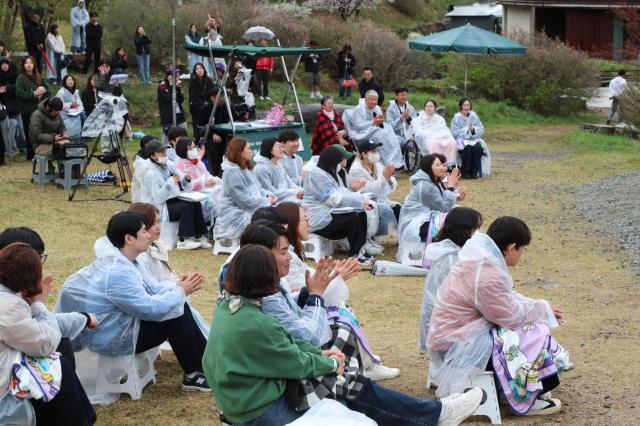
At the event held on the 22nd, about 50 people — including people with disabilities and older residents living in Hapcheon, as well as members of the sharing trip group — were invited as special guests. They watched an open-mic performance for JTBC’s music program “Begin Again,” staged against a backdrop of fully bloomed red azaleas.
Local governments supported operations and transportation. Hapcheon County provided the sharing carts, and Ulsan Metropolitan City provided a wheelchair lift-equipped vehicle. Footage from the event is scheduled to be released in May via JTBC and YouTube.
Park Jeong-ung, head of the Korea Tourism Organization’s National Tourism Division, said he hopes Hwangmaesan’s azaleas and the music will be remembered as “an unforgettable spring gift.” He said the agency will seek related projects that people vulnerable in travel can feel directly, aiming to build a tourism powerhouse without barriers.
The Open Tourism Site development program supports renovations to tourism infrastructure so people with disabilities, older adults and families traveling with infants and young children can travel without restrictions. It also provides comprehensive support for experience content, visitor guidance systems and worker training. Launched in 2015, the program has surpassed 200 open tourism sites nationwide this year.
* This article has been translated by AI.
Copyright ⓒ Aju Press All rights reserved.