

“The candidates who received the autobiographies he wrote for them said they were pleased with the past he had added and imagined, and some even copied lines directly into campaign materials.”
In Lee Ki-ho’s novel “Suin,” Park Su-yeong lives with relentless drive. A skilled ghostwriter, he produces autobiographies for numerous politicians.
After debuting four years earlier by winning a novel contest, Park cannot write a second book. Instead, he survives by becoming what the novel portrays as an exceptionally capable ghostwriter — and, it suggests, a copywriter adept at political messaging.
When he finally retreats to a remote mountain village in Gangwon Province to write again, South Korea is hit by two nuclear power plant explosions that leak radiation.
U.N.-dispatched investigators then assess individuals and plan relocations around the world based on jobs and qualifications. Asked what he does, Park answers in a shrinking voice: “A ... a novelist.”
Even after turning out more than 1,000 pages a month as a professional ghostwriter and crafting polished language to elevate politicians, he defines himself, in the end, as a novelist.
“Why does my life have to please you?”
In the drama “Everyone Is Fighting Their Own Worthlessness,” Hwang Dong-man is a film director — or, more precisely, an aspiring one. He has not officially debuted. For 20 years, he has carried around a script titled “We’ll Make the Weather for You,” trying to break in, without success.
As his attempts fail, Hwang also works relentlessly. He teaches screenwriting at an academy, takes part-time catering jobs and joins a clinical trial as a subject for an “Emotion Watch” test.
At the academy, some students sincerely “admire” him. He lectures with forceful talk, and his daily routine includes watching films and delivering harsh critiques — suggesting real talent as a critic.
Still, because he cannot give up on directing, he lives under the label of “unemployed in his 40s.”
To prove he is a novelist, Park stands before the Gwanghwamun Kyobo Book Centre, sealed off with 25 meters of concrete to block radiation. Inside are unsold copies of his novel. To retrieve them, he begins hacking at the barrier with a pickax.
After days of repeated “digging,” he learns the grain of the concrete, how to use less force and how to move with sharper efficiency.
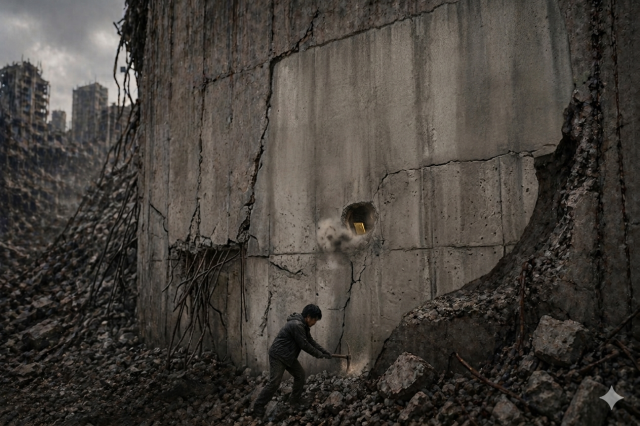
Only after reaching a point where he can no longer tell whether he is wielding the pickax or the pickax is wielding him — and realizing the work is not so different from writing — does he receive approval to relocate overseas. About 30 centimeters of wall remain. The tunnel he has carved becomes proof that he is a novelist. In other words, the tunnel is his novel.
How, then, does Hwang prove he is a director — that he exists at all? He fights his sense of worthlessness by lashing out at members of an “Eight-Person Club,” friends from childhood when he was “nobody” and they were close. By insisting, again and again, that he is not worthless, he struggles to prove his own presence.
At times, Hwang seems less focused on becoming a director than on “not disappearing by even 1 gram from this world.” When Byeon Eun-a — the first person to read his script seriously — delivers a blunt critique, saying the protagonist “has no power,” Hwang cannot respond and instead binges on food.
The works suggest that unmet value does not come from worldly success, but from keeping the five senses open in each moment. Park’s “digging” does that, and so do Hwang’s bingeing, his barbed remarks and his persistence.
Hwang talks constantly, reliably provokes the Eight-Person Club, keeps pushing his script, eats regular meals, listens to music and watches films at home every day. Even as she tears into his writing, Byeon says, “Director, you’re someone with a thousand doors open,” recognizing his heightened awareness.
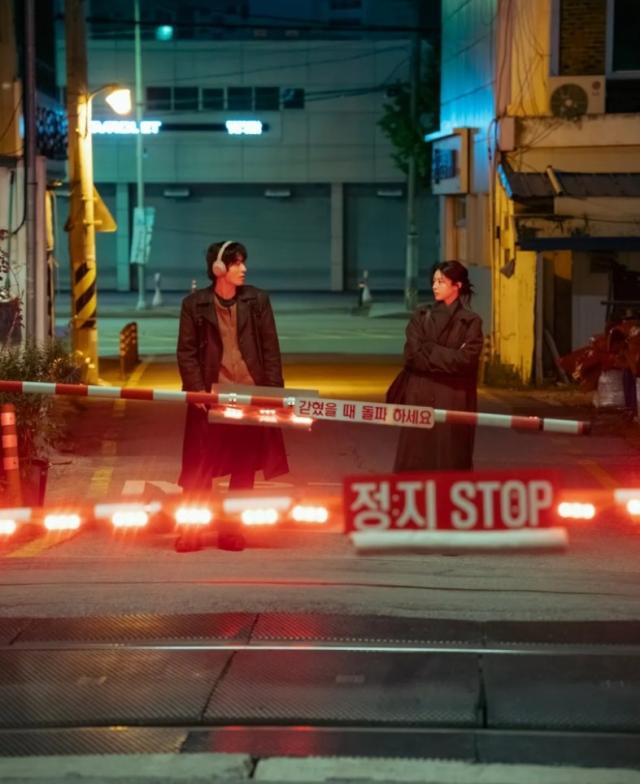
“Suin” and “Everyone Is Fighting Their Own Worthlessness” point to value in staying open to experience — feeling and responding to each moment, and meeting life with steady effort. The message is that even someone poor, dismissed or seemingly ordinary can still shine.
Those who can see that shine may “admire” it — or envy it. The drama suggests that Byeon, who closed off her senses to avoid being hurt, decides to experience Hwang. It also suggests that Park Gyeong-se, a film director in the Eight-Person Club who has released five films, especially hates Hwang because he recognizes something real in him.
* This article has been translated by AI.
Copyright ⓒ Aju Press All rights reserved.