

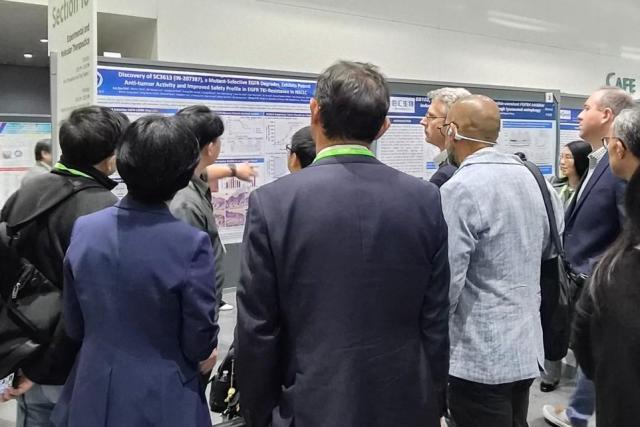
Dong-A ST said April 24 that it and its subsidiary Aptis, an antibody-drug conjugate (ADC) specialist, presented 10 preclinical studies on next-generation cancer pipeline programs at the American Association for Cancer Research meeting (AACR 2026).
The presentations included results on a PARP7 inhibitor, EGFR-targeted protein degraders and bispecific antibody ADCs.
Dong-A ST’s PARP7 inhibitor candidate SC5024 showed a “dual anti-cancer mechanism” in preclinical testing, inducing both tumor-cell suppression and immune activation, the company said, suggesting potential for use alone or in combination. It also presented an anti-cancer strategy using EGFR-targeted protein degraders SC3613 and SC3499, co-developed with HK inno.N, designed to selectively eliminate mutant EGFR proteins.
The companies also outlined a treatment strategy based on a bispecific ADC platform. Bispecific ADCs combining Dong-A ST’s bispecific antibody platform with Aptis’ linker technology — Nectin-4×PD-L1, HER2×AXL and Claudin18.2×HER2 — were analyzed using omics and AI based on patient-derived cancer cells, and were presented as having potential to address drug resistance and tumor heterogeneity.
Oh Yun-seok, Dong-A ST vice president and chief scientific officer, and Choi Hyeong-seok, president of Aptis, introduced key pipeline programs and research strategy at the meeting and discussed possible collaboration with global drugmakers, the companies said.
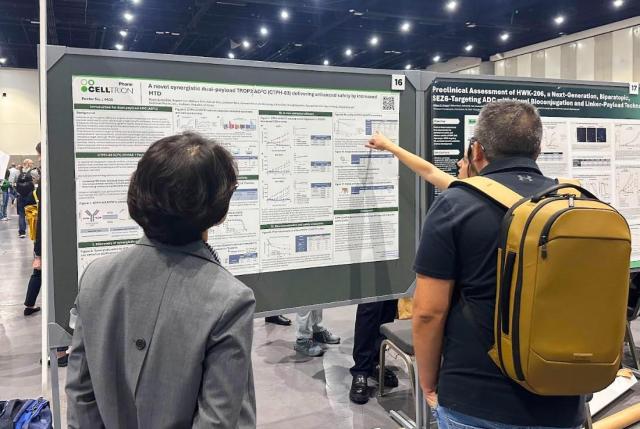
Celltrion Pharm said April 24 it presented research results at AACR 2026 in San Diego on two new pipeline candidates based on its dual-payload ADC platform.
The company said it first unveiled the platform at AACR 2025 with its HER2-targeting candidate CTPH-02, which links two payloads with different mechanisms of action to a single antibody. The platform showed strong cytotoxicity not only in cell lines with high HER2 expression but also in those with low expression, it said.
Celltrion Pharm also presented CTPH-08, a candidate targeting FRα, applying the platform to a new target. The company said the data supported the scalability of the dual-payload approach and suggested potential to address tumor heterogeneity and drug resistance.
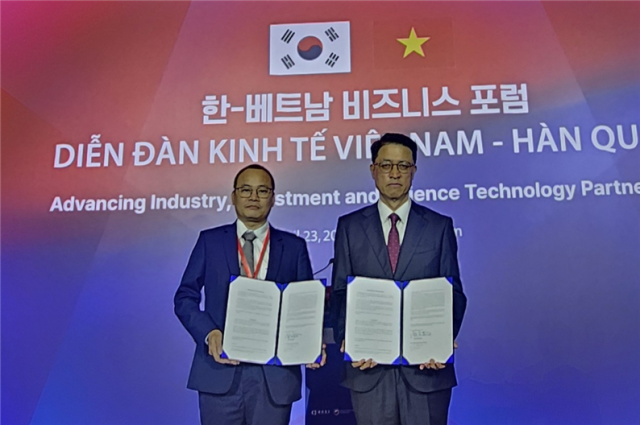
Hyundai Bioscience said April 24 it signed a broad memorandum of understanding with Vietnamese pharmaceutical company Vepaco covering approval, importation, distribution and supply of an antiviral drug in Vietnam.
The company said the signing took place during a forum attended by key figures from both countries to discuss economic cooperation, with South Korea’s minister of trade, industry and energy and Vietnam’s minister of finance present.
Hyundai Bioscience said the agreement sets out basic directions and a roadmap for jointly pursuing regulatory approvals and supply projects. The companies plan to form an executive-level working group to hold regular meetings and to detail cooperation tasks, including patient linkage using local medical and pharmacy networks.
Hyundai Bioscience said it aims to link dengue clinical work in Vietnam with approval and commercialization strategies.
* This article has been translated by AI.
Copyright ⓒ Aju Press All rights reserved.