

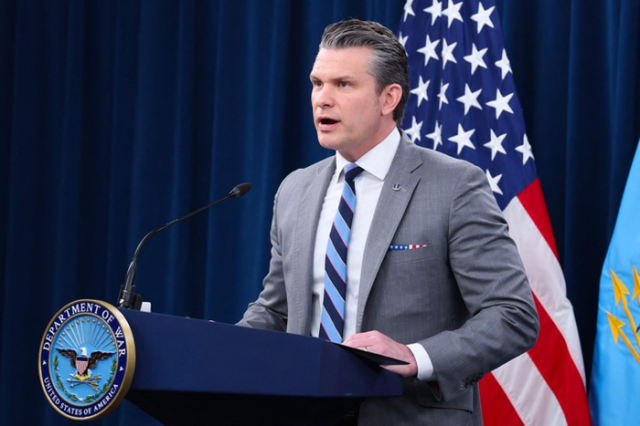
Bloomberg reported on April 24 that Hegseth criticized what he called “free-riding” by Europe and Asia in connection with Hormuz transit. GB News said Hegseth told a Pentagon news conference that Europe and Asia had benefited for decades from U.S. protection, but that “the time for free-riding is over.”
He was also quoted as stressing that alliances are not one-way, a message widely read as a call for countries with major stakes in stable passage through Hormuz to share costs and responsibilities.
At the same news conference, Reuters reported that Hegseth said the U.S. maritime blockade on Iran was expanding. “Our blockade is growing and expanding worldwide,” he said.
Hegseth said the U.S. Navy has so far turned back 34 vessels in the Strait of Hormuz. He added that without U.S. Navy approval, ships cannot sail from the strait to anywhere in the world.
The remarks were seen as a signal that Washington is seeking to link Hormuz transit to burden-sharing by allies. The strait is a critical sea lane for Middle Eastern crude oil and liquefied natural gas, and major importers in Europe and Asia have a direct interest in its stability.
Hegseth also left room for negotiations with Iran, saying Iran has a chance to reach a “good deal” with the United States. He did not provide details on any timetable or whether the blockade could be eased.
* This article has been translated by AI.
Copyright ⓒ Aju Press All rights reserved.