

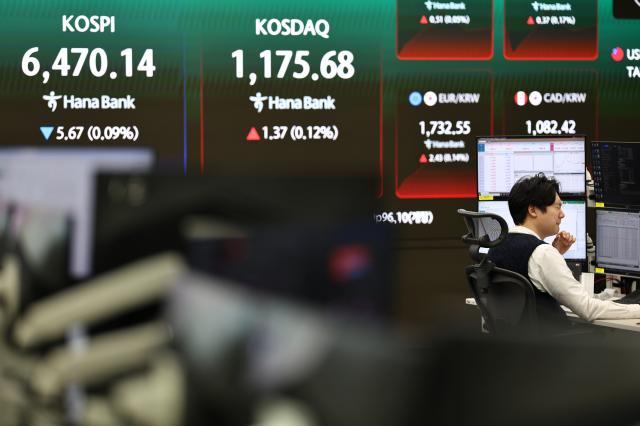
After setting a record high and completing a so-called W-shaped rebound, South Korea’s stock market is expected to face a key test next week over whether the rally can extend. Semiconductor-driven earnings momentum has supported gains, but heavy foreign selling and a U.S. monetary policy event could increase volatility.
According to the Korea Exchange, the KOSPI closed the previous session down 0.18 point, or flat, at 6,475.63. The index rose to the 6,490 level early in the day but gave up gains amid large foreign selling. In the main board market, foreigners net sold 2.1022 trillion won, while individuals and institutions net bought 1.5066 trillion won and 646.1 billion won, respectively.
The KOSDAQ ended up 29.53 points, or 2.51%, at 1,203.94. Foreigners and institutions net bought 806.5 billion won and 179.6 billion won, while individuals net sold 963.8 billion won.
This week, domestic shares swung between gains and losses as investors weighed post-record-high fatigue and geopolitical risks. Analysts said expectations for semiconductor earnings have collided with Middle East uncertainty. While negotiations between the United States and Iran have continued, tensions tied to the Strait of Hormuz and rising oil prices have not fully eased, they said.
Next week, the durability of the semiconductor earnings story is expected to be a central driver. SK hynix posted its best-ever first-quarter results, reinforcing expectations for an industry upturn, and optimism could spread across related sectors. In April export data released recently, semiconductor exports rose more than 180% from a year earlier, maintaining a strong trend.
Market watchers also noted that the KOSPI’s rise has been driven more by improving corporate earnings than by liquidity. Upward revisions to profit estimates, led by semiconductors, have helped underpin fundamentals. Still, the sharp run-up over a short period and continued foreign selling are seen as near-term sources of volatility.
Foreign flows are viewed as a key swing factor. Foreign investors have remained net sellers in the cash market, and directional buying in the futures market has been limited, analysts said. That could restrain program buying and reduce the index’s upward momentum.
Overseas, investors are watching U.S. monetary policy and major economic data. The Federal Open Market Committee meets April 29-30 local time, and while a rate hold is widely expected, markets are focused on how the Fed addresses inflation pressure linked to higher oil prices. U.S. first-quarter gross domestic product, the personal consumption expenditures inflation gauge and earnings from major big tech companies are also seen as potential volatility triggers.
Some in the market said that if higher oil prices intensify inflation concerns, expectations for rate cuts could weaken. Others said the KOSPI could keep its uptrend if earnings improvements, led by semiconductors, continue.
Na Jeong-hwan, a researcher at NH Investment & Securities, said, "The KOSPI is in a phase where expectations for earnings growth have been reflected in prices, so investors need to focus on sectors where results are being confirmed," adding that "semiconductors, power equipment and defense remain valid leading sectors."
Kang Jin-hyeok, a researcher at Shinhan Investment Corp., said, "After a sharp short-term drop, the market has succeeded in a W-shaped rebound, so whether gains continue will depend on earnings and macro variables," and added that investors should keep in mind the possibility of greater volatility driven by geopolitical risks and inflation factors.
Some analysts also said the recent pullback has not translated into damage to corporate earnings. With profit estimates continuing to rise, particularly in semiconductors and industrials, they said the current move looks more like a short-term, flow-driven adjustment than a break in the broader trend. As a result, they expect stock-specific performance to dominate over a clear index direction for the time being.
* This article has been translated by AI.
Copyright ⓒ Aju Press All rights reserved.