

Trump said it that night at a news conference, wearing a tuxedo. It was less than two hours after gunfire erupted at a dinner. It sounded like a joke, but it was not. He has faced gunfire three times.
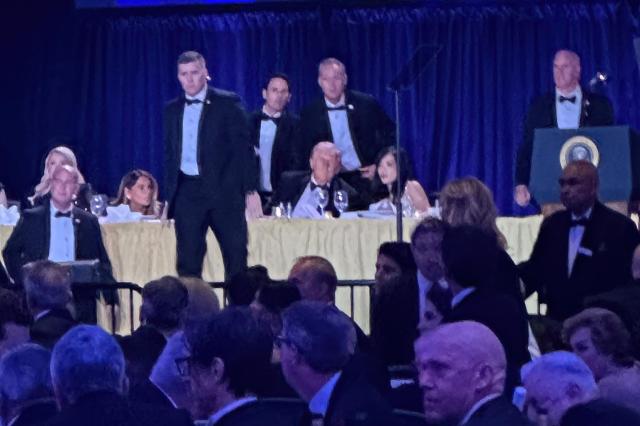
This time, the shots came without warning at the Washington Hilton Hotel ballroom. Amid tuxedos and evening gowns at a "Washington night," an unfamiliar sound cut through the room. Trump said he first thought a tray had fallen. Melania noticed first. "That's a bad sound." She was right.
Agents secured the stage. Cabinet members ducked under tables. In one corner, a waitress screamed in Spanish: "I don't want to die here." On the floor were half-eaten salad, crumpled napkins and a single high heel.
Trump survived again. But survival is no longer the ending.
In 2024, a bullet grazed his ear at a campaign stop in Pennsylvania. Later that year, a sniper hid in bushes at a Florida golf course. This time, an armed man sprinted toward a security checkpoint at the dinner venue.
Trump said, "The more influence you have, the more you get attacked." That may be true, but it does not capture what has changed. In the United States, it is not only a leader at risk; politics itself has become more dangerous.
A sitting member of Congress was shot. A conservative commentator died at a lecture hall. The husband of a former House speaker was attacked with a hammer. A Democratic governor's home was set on fire. Sorting out which side is threatened is increasingly beside the point.
The irony is stark: The president of the world's most powerful military was attacked at a dinner in his own country.
Trump said the incident showed the need for a new White House banquet hall: bulletproof glass, drone defenses and a fully controlled space. The plan carries a $400 million price tag and is in litigation.
Security is necessary. But when a space meant to symbolize openness turns into a fortress, questions follow about how open the system can remain. It is a paradox of a democracy closing itself to protect itself.
The strain did not arise in a vacuum. Immigration enforcement, alliance realignments and clashes with the media have drawn sharp reactions at home and abroad to Trump administration policies. Policy disputes do not justify violence. But as politics runs on extreme language, the threshold for action drops. What once seemed unthinkable becomes imaginable, and sometimes becomes real.
The war with Iran is now in its second month. In joint U.S.-Israeli operations, about 1,200 Iranians and six U.S. troops have been killed. Trump canceled a negotiating delegation's trip to Pakistan just before takeoff, saying, "We have all the cards." Iran said it would not sit at the table as long as the blockade continues.
The structure is simple: Neither side yields, and each waits out the other.
Iran's foreign minister, leaving Pakistan, said, "We'll have to see whether the United States is truly serious about diplomacy." Trump said later that night Iran's proposal was "much better but still not enough." The talks appear to continue, but in practice remain stuck.
Investigators believe the suspect, Cole Thomas Allen, 31, acted alone. Trump said he agreed and drew a line under any likely Iran connection. "He has very serious mental problems," Trump said. One agent was shot but survived because of a bulletproof vest. The suspect's apartment is being searched. The motive remains unclear.
Like the gunfire at the dinner, like the stalemate with Iran, the moment was loud but the outcome is uncertain, and nothing is resolved.
Trump joked that no one told him the job was this dangerous. What no one can say yet is where this war and this tension end. Washington and Tehran do not have that answer.
* This article has been translated by AI.
Copyright ⓒ Aju Press All rights reserved.