

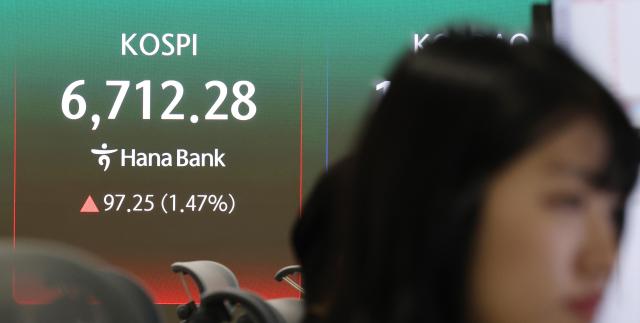
South Korea’s stock market has risen to the world’s eighth-largest by market capitalization, overtaking the United Kingdom as a surge in artificial intelligence and semiconductor shares pushed the benchmark KOSPI sharply higher, Bloomberg News reported on the 28th.
Bloomberg data showed South Korea’s market capitalization has climbed 45% so far this year to about $4.04 trillion, edging past the U.K. at $3.99 trillion. As recently as the end of 2024, the U.K. market was about twice the size of South Korea’s, but South Korea’s value expanded rapidly over the past year or so to move ahead, Bloomberg said.
The rally has been driven largely by the AI boom. Samsung Electronics and SK hynix, seen as major beneficiaries of the AI-led semiconductor “supercycle,” have been rising in earnest since last year and helped lift the broader market. The KOSPI, after first clearing 6,600 on the previous day, also broke above 6,700 on the 28th, extending its record run.
Taiwan’s stock market, led by Taiwan Semiconductor Manufacturing Co., the world’s largest contract chipmaker, also surpassed the U.K. to rank seventh globally, Bloomberg said. Taiwan’s market capitalization was put at $4.48 trillion. The United States ranked No. 1 at $75.04 trillion, followed by mainland China at $14.84 trillion, Japan at $8.19 trillion, Hong Kong at $7.41 trillion, India at $4.97 trillion and Canada at $4.49 trillion, according to Bloomberg’s figures.
Francesco Chan, an emerging markets and Asia-Pacific investment specialist at JPMorgan Asset Management in Hong Kong, said the rapid rise of South Korea and Taiwan reflects a structural reshaping of global equity markets rather than a tactical asset-allocation shift. “Structural capital inflows are continuing into these countries, which play a central role in the AI supply chain, backed by the advantages of the ‘supercycle’ in advanced foundry and memory,” he said.
By contrast, the U.K. market has appeared more removed from the AI cycle, with its benchmark FTSE up just 4% so far this year. Analysts cited Europe’s heavier weighting toward traditional sectors such as financials, consumer staples and energy, compared with South Korea’s larger share of AI and semiconductor-related stocks.
Patrick Kellenberger, an emerging-market equity strategist at Swiss asset manager Lombard Odier, said factors including AI, rising global defense spending and corporate governance reforms have provided strong momentum for South Korean and Taiwanese equities. “Europe is still struggling to commercialize innovation and scale it up,” he said, adding that creating conditions for innovative companies to emerge and grow is important but takes time.
Bloomberg noted that despite strong chip-company earnings, South Korea and Taiwan still have gross domestic products of about $1.9 trillion and $1 trillion, respectively, below the scale of major European economies such as the U.K., Germany and France, each with GDP above $3 trillion.
* This article has been translated by AI.
Copyright ⓒ Aju Press All rights reserved.