

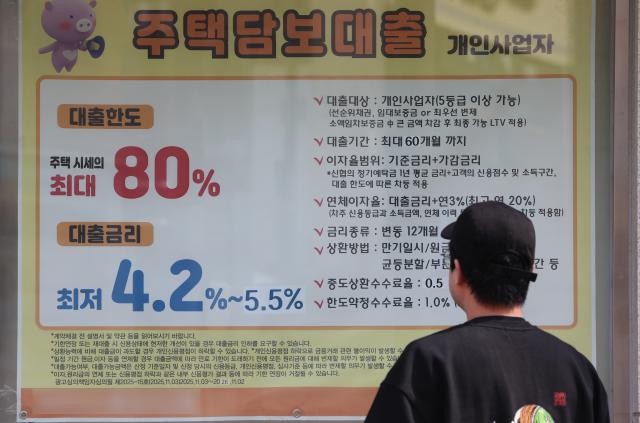
Mortgage rates in South Korea rose for a sixth straight month, reaching their highest level in 2 years and 4 months.
According to the Bank of Korea’s “weighted-average interest rates of financial institutions” data released on the 28th, the average rate on new mortgage loans at deposit-taking banks in March was 4.34% a year, up 0.02 percentage points from the previous month. It was the highest since November 2023 (4.48%).
Lee Hye-young, head of the BOK’s financial statistics team, said the increase reflected a sharp rise in long-term benchmark rates, including the five-year bank bond yield.
Rates on general unsecured loans also rose, up 0.04 percentage points to 5.57%, turning higher for the first time in three months since January. The overall household loan rate climbed 0.06 percentage points to 4.51%.
Across household and corporate lending, the overall bank loan rate fell 0.06 percentage points to 4.20%, as corporate loan rates declined on support such as preferential rates aimed at expanding corporate credit. Rates for large companies (4.11%) and small and midsize firms (4.17%) fell 0.02 and 0.11 percentage points, respectively.
The share of fixed-rate mortgages dropped sharply over the month, falling 10.3 percentage points to 60.8% from 71.1%. The fixed-rate share of all household loans also slid to 35.5% from 43.1%, the lowest since September 2022 (33.6%).
The average rate on new savings deposits fell 0.01 percentage points to 2.82% a year, reversing course after a month. Rates on time deposits and other pure savings deposits (2.79%), as well as market-linked products such as financial bonds and certificates of deposit (2.98%), also slipped 0.01 percentage points each.
With loan rates falling more than deposit rates, the gap between new loan rates and savings deposit rates narrowed by 0.05 percentage points to 1.38 percentage points. However, the gap based on outstanding balances, rather than new lending, widened 0.01 percentage points to 2.27 percentage points.
* This article has been translated by AI.
Copyright ⓒ Aju Press All rights reserved.