

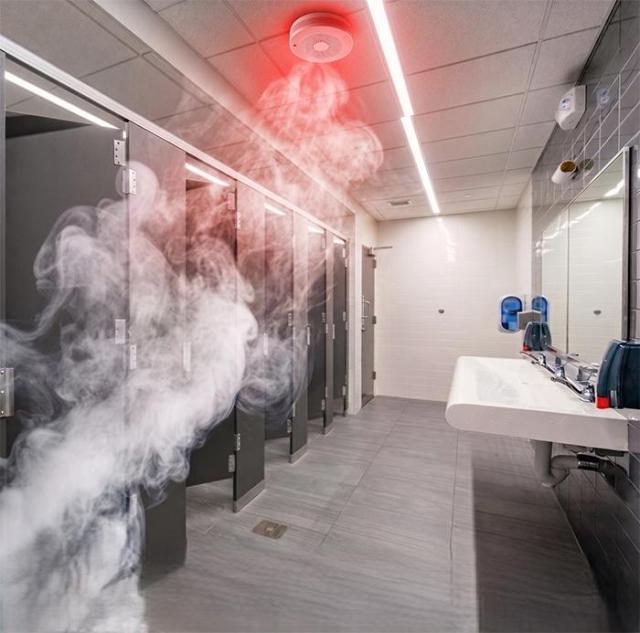
Jangsu Communications, a partner of Motorola Solutions, said it plans to supply the HALO smart sensor to strengthen safety in school blind spots where CCTV installation is restricted, focusing on elementary schools.
The device, developed by HALO Smart Solutions Inc., is an environmental and behavior-detection sensor built without a camera or microphone, a design intended to preserve privacy. The company said that makes it suitable for areas such as restrooms, locker rooms and hallway blind spots, where privacy protections limit conventional video-based security.
Jangsu said the HALO sensor can analyze more than 20 environmental factors with a single unit, detecting changes in sound patterns, movement, air quality and specific chemical components in real time. It identifies anomalies and sends immediate alerts to administrators. Because the system processes “event-based information” rather than storing video or audio, it is designed to reduce the burden of handling personal data.
One feature highlighted for schools is e-cigarette vaping detection. Jangsu said the sensor’s algorithm analyzes fine particles and chemical changes in the air to determine whether smoking has occurred and is designed to distinguish attempts to mask odors with perfume or air fresheners.

The system also includes indoor air-quality monitoring, continuously measuring key indicators such as carbon dioxide (CO₂), carbon monoxide (CO) and volatile organic compounds (VOC). It can issue warnings when readings exceed set thresholds, data that can be used to judge when ventilation is needed or to support indoor-environment improvements.
Jangsu said the sensor can also detect abnormal noise, impact sounds and unusual behavior through movement and sound-pattern analysis, offering a tool to help spot early signs of school violence or accidents. The company said linking the system with lighting and HVAC controls could enable automatic operation to improve energy efficiency and expand into predictive maintenance by using temperature and humidity data to detect equipment issues in advance.
On integration, Jangsu said the system supports an open API, allowing it to connect with existing security platforms and building management systems and to be customized for different operating environments. The company cited reported use cases at some U.S. education institutions, including Castleberry Independent School District and Green Dot Public Schools, for vaping detection, air-quality improvements and accident prevention.
Industry observers say non-identifying, sensor-based security is drawing attention as an option that can address both privacy protection and safety management, particularly in settings such as schools where privacy standards are strict.
A Jangsu Communications official said the company plans to expand the product in a form suited to South Korea’s education environment.
“The device has been recognized in the field of security technology innovation,” the official said. “We expect it can help strengthen student safety by covering CCTV blind spots while reducing the management burden on teachers.”
* This article has been translated by AI.
Copyright ⓒ Aju Press All rights reserved.