

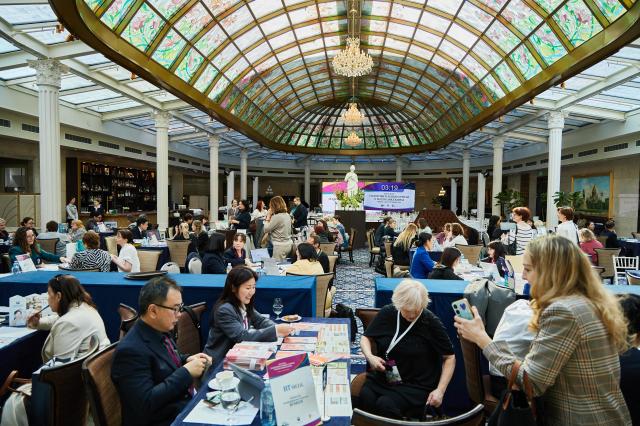
The Korea Tourism Organization said April 29 that its large-scale local sales push targeting high-spending medical tourists from Russia and Central Asia has concluded, generating 346 contracts and an expected 5.8 billion won in sales.
◆ Central Asia emerges as a key target in Korea’s medical tourism market
The number of foreign medical tourists visiting South Korea topped 2 million for the first time last year, reaching 2.01 million. Among them, visitors from Russia and Kazakhstan totaled 35,450, up about 14% from a year earlier. Their average spending per person was about 40% higher than the overall average, making them a high-value market, the organization said.
To capture demand, the organization held “2026 Korea Medical Tourism Promotion Briefings” on April 17 and 20 in Moscow and St. Petersburg. Twenty-four South Korean medical institutions and agencies joined the events, which drew about 330 local industry participants for business consultations. Product sales training was also offered to help local partners better understand the offerings.
◆ From trade fair to one-on-one sessions, 346 contracts signed
In Almaty, Kazakhstan, the organization took part in the region’s largest tourism fair, the International Tourism Fair (KITF), held April 22-25. With 24 South Korean organizations, it operated a Korea tourism promotion pavilion highlighting medical and wellness travel products.
On April 22, it hosted a tourism exchange event with 40 local agencies. On April 25, it staged a consumer-focused promotion at a major shopping mall linking K-beauty and K-food, drawing about 50,000 visitors. That day, it also held tailored one-on-one consultations at the InterContinental hotel with eight South Korean specialist doctors to showcase Korea’s advanced medical services.
Across the roadshow, the organization reported 4,397 B2B and B2C consultations and said it expects 346 contracts and about 5.8 billion won in sales.
Lee Dong-seok, head of the Korea Tourism Organization’s medical and wellness team, said the group will use the local networks built through the campaign to position South Korea as a tourism destination combining advanced medical technology with K-wellness.
The organization said it has pursued a more segmented medical tourism strategy since last year, including building a networking club for affluent Chinese visitors, holding Japan’s first large-scale medical tourism event, and developing a new market in Erdenet, a mining city in Mongolia.
* This article has been translated by AI.
Copyright ⓒ Aju Press All rights reserved.