

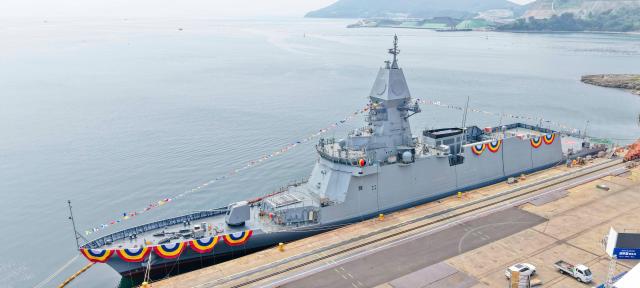
The South Korean Navy and the Defense Acquisition Program Administration held a launching ceremony Tuesday for the frigate Jeju at SK Oceanplant in Goseong, South Gyeongsang Province.
The 3,600-ton ship is the fourth Ulsan-class Batch-III frigate and is intended to replace older frigates (FF) and patrol combat corvettes (PCC) now in service, officials said.
After sea trials, Jeju is to be delivered to the Navy in June 2027 and then deployed following its commissioning process.
About 150 people attended the ceremony, including Joint Chiefs of Staff Chairman Jin Yeong-seung, Navy Chief of Staff Kim Kyeong-ryul, DAPA Defense Capability Acquisition Program Bureau chief Jeong Jae-jun, and SK Oceanplant CEO Kang Young-gyu.
Jeju is 129 meters (423 feet) long, 14.8 meters (49 feet) wide and 38.9 meters (128 feet) high. It is equipped with a 5-inch gun, the Korean Vertical Launching System (KVLS), anti-ship and missile-defense guided missiles, ship-to-ship guided missiles, tactical ship-to-surface guided missiles, and long-range anti-submarine torpedoes.
Its integrated sensor mast carries infrared search-and-track equipment and a domestically developed multifunction phased-array radar. The four fixed radar panels provide 360-degree detection and tracking of air and surface targets and can engage multiple aerial targets at the same time, the Navy said.
The ship uses a hybrid propulsion system to reduce noise and operates a domestically developed hull-mounted sonar (HMS) and a towed array sonar system (TASS), giving it enhanced anti-submarine warfare capability, officials said.
Jin said the military must strengthen its commitment to self-reliant defense and its readiness posture. He said the armed forces are working to advance “AI-based manned-unmanned combined combat capability” by upgrading evolving K-defense industry technologies such as unmanned surface vessels and unmanned aircraft, in an effort to become “a strong military that can fight and win.”
He said the effort would help support peace on the Korean Peninsula through strength, protect lives and property, and build a military “trusted by the people.”
The 3,600-ton ship is the fourth Ulsan-class Batch-III frigate and is intended to replace older frigates (FF) and patrol combat corvettes (PCC) now in service, officials said.
After sea trials, Jeju is to be delivered to the Navy in June 2027 and then deployed following its commissioning process.
About 150 people attended the ceremony, including Joint Chiefs of Staff Chairman Jin Yeong-seung, Navy Chief of Staff Kim Kyeong-ryul, DAPA Defense Capability Acquisition Program Bureau chief Jeong Jae-jun, and SK Oceanplant CEO Kang Young-gyu.
Jeju is 129 meters (423 feet) long, 14.8 meters (49 feet) wide and 38.9 meters (128 feet) high. It is equipped with a 5-inch gun, the Korean Vertical Launching System (KVLS), anti-ship and missile-defense guided missiles, ship-to-ship guided missiles, tactical ship-to-surface guided missiles, and long-range anti-submarine torpedoes.
Its integrated sensor mast carries infrared search-and-track equipment and a domestically developed multifunction phased-array radar. The four fixed radar panels provide 360-degree detection and tracking of air and surface targets and can engage multiple aerial targets at the same time, the Navy said.
The ship uses a hybrid propulsion system to reduce noise and operates a domestically developed hull-mounted sonar (HMS) and a towed array sonar system (TASS), giving it enhanced anti-submarine warfare capability, officials said.
Jin said the military must strengthen its commitment to self-reliant defense and its readiness posture. He said the armed forces are working to advance “AI-based manned-unmanned combined combat capability” by upgrading evolving K-defense industry technologies such as unmanned surface vessels and unmanned aircraft, in an effort to become “a strong military that can fight and win.”
He said the effort would help support peace on the Korean Peninsula through strength, protect lives and property, and build a military “trusted by the people.”
* This article has been translated by AI.
Copyright ⓒ Aju Press All rights reserved.