

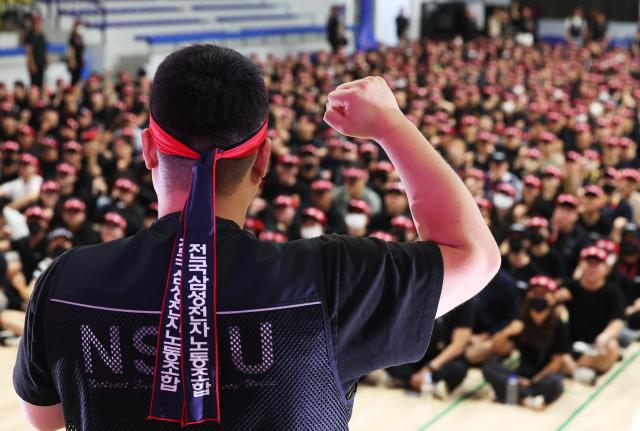
Samsung Electronics’ union, which is in a dispute over performance bonuses, said production results in the foundry (contract manufacturing) business plunged 58.1% during nighttime hours on the day of a rally on the 23rd. It also said memory production results fell 18.4%. The union added an estimate that an 18-day general strike would cause more than 30 trillion won in damage to the company.
In semiconductor fabs, a shutdown is not simply a delay in output; it can also reduce yield, the share of usable chips. If Samsung fails to deliver on time to major customers amid shortages of DRAM and NAND that have fueled the current boom, it could face large penalty payments. There is also a risk customers could shift orders away from Samsung.
Samsung sits at the top of a vast semiconductor supply chain, and even a brief strike can ripple through that ecosystem. Ultimately, consumers can feel the impact. Using projected company losses as a bargaining weapon in a strike risks turning pressure into something closer to coercion.
Capital and labor carry different risks, reflected in wages and bonuses. Investors accept the risk of losses in exchange for the right to pursue unlimited profit. Workers, in exchange for stable labor, receive wages rather than bearing the full downside. Even in today’s boom, Samsung’s semiconductor division posted large losses in 2023–2024, making future investment difficult to ignore.
In a recent lunch with a source, the conversation turned to artificial intelligence. The takeaway was that AI now handles more than 90% of routine company work.
A draft report is assigned to AI. After the draft is sent to other departments, feedback returns within an hour — also produced with AI. The expanded report is then consolidated again with AI. When an executive asks for additional items, AI is used to compile a final version.
The entire process took less than half a day. AI produced both the draft and the final report, including collecting and analyzing data to extract meaning from the numbers. The CEO who received it then fed the full report into AI and issued a simple instruction:
"Summarize only the key points and tell me again."
About 10 people were involved along the way, but the question remains whether the report was written by those employees or by AI — and who actually understood it. As a practical matter, AI can end up knowing more than the people who touched the document.
The story highlights AI’s productivity, but also how inefficient human workflows can be. It is not surprising that AI is evolving toward systems that operate with minimal human involvement.
In semiconductor processes that handle hazardous chemicals, many robots are already at work. Factories where AI automatically runs production and management are no longer far-fetched, and such efforts are underway. Samsung is developing technology aimed at unmanned factories by 2030. AI would handle chip circuit design, while robots equipped with AI would manage toxic chemicals and move wafers among equipment.
AI would also take over back-end steps such as inspection and fine assembly. If AI and robots replace workers, the idea of the “skilled worker” could fade. Companies may say robots are being considered to ease labor shortages, but over time the push for unmanned factories could be justified as a way to avoid friction with organized labor.
* This article has been translated by AI.
Copyright ⓒ Aju Press All rights reserved.