

Chinese-language food and beverage franchises are rapidly expanding their presence in South Korea’s dining market, with once-budget Chinese fare increasingly repositioned as trendy, premium spending through malatang, hot pot and milk tea.
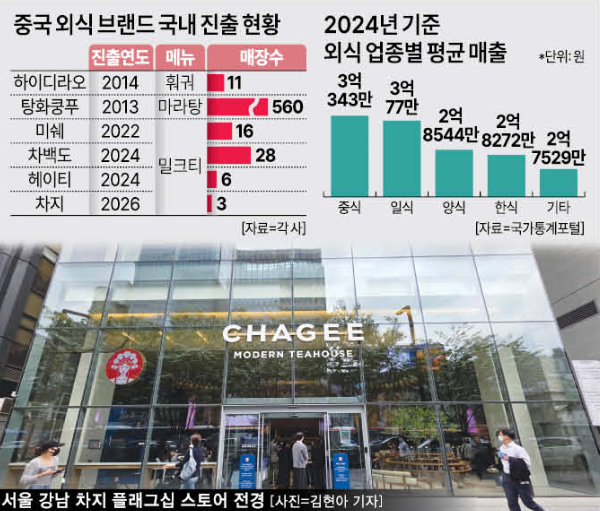
According to industry officials on April 29, Chinese milk tea brand Chagee plans to open stores simultaneously on April 30 in Gangnam, Sinchon and Yongsan. Chagee, which reinterprets traditional tea in a modern style, opened its first store in China’s Yunnan province in 2017 and has expanded quickly. It now operates about 7,000 stores across Greater China and in Malaysia, Thailand, Singapore, Indonesia, the Philippines, Vietnam and the United States.
Other tea brands have already entered South Korea. Chinese milk tea brand Chabaidao entered in 2024 and is preparing to open its 28th store. Heytea, which arrived around the same time, has expanded from Apgujeong to major retail districts including Hongdae, Myeongdong and Garosu-gil. Milk tea brand Misher, which entered in 2022, operates 16 stores centered on university areas in Seoul.
Meal-focused brands are also growing. Hot pot chain Haidilao, which entered South Korea in 2014 with its first store in Myeongdong, has expanded to locations including Jeju and Daegu and now directly operates 11 stores nationwide. Despite a per-person check of about 40,000 to 60,000 won, it has drawn strong interest among younger consumers, with waits of more than three hours reported. Its sales rose 50.9% to 117.7 billion won last year from 78.1 billion won a year earlier, topping 100 billion won. Operating profit nearly doubled to 20.2 billion won from 11.0 billion won.
Malatang franchise Tanghua Kungfu, which arrived in 2013, had 560 stores as of March, becoming the first malatang brand in South Korea to surpass 500 outlets. Sales rose 14.6% last year to 25.4 billion won, and operating profit increased to 11.0 billion won from 10.5 billion won. Its operating margin was 43.5%.
Analysts link the overseas push to slowing growth at home. China’s National Bureau of Statistics said 2024 restaurant revenue rose 5.3% from a year earlier to 5.5718 trillion yuan, a sharp slowdown from growth above 20% in 2023. With competition intensifying in the domestic market, brands that already run thousands of stores are increasingly looking abroad.
South Korea is seen as an attractive target because of strong consumer purchasing power and the speed at which trends spread on social media, helping new brands gain traction. Industry officials also point to the deep penetration of Chinese e-commerce platforms such as AliExpress, Temu and Shein, which they say makes it easier to gauge Korean consumer preferences and data.
“South Korea is a market with strong cultural influence,” a representative of a Chinese-language dining brand said. “Success in Korea is seen as a signal that a brand can work in global markets, so it is viewed as an important test bed.”
Some warn the trend could add pressure to South Korea’s dining industry as competition intensifies amid weak domestic demand. The number of franchised food-service outlets in South Korea rose 1.5% last year to 183,714, while the franchise closure rate hit a record 15.8%.
“Chinese franchises enter the Korean market with experience operating large-scale stores and strong cost competitiveness,” a South Korean dining franchise official said. “For domestic brands and self-employed owners, the competitive environment is bound to become even tougher.”
* This article has been translated by AI.
Copyright ⓒ Aju Press All rights reserved.