

Since the second half of last year, exchange-traded funds have been one of the main drivers of the stock market’s rise, drawing heavy inflows from retail investors seeking returns with less single-stock risk. But many ETFs are increasingly hard to tell apart, with multiple products tracking the same index or using nearly identical structures. Market participants warn that “copycat” competition is becoming entrenched. A priority-rights system was introduced to curb the problem, but its effectiveness is in doubt.
◆ Look-alike ETFs multiply
According to the financial investment industry on April 29, net assets in South Korea’s ETF market totaled 431.447 trillion won as of April 28, up 45.1% from 297.1401 trillion won at the end of last year. The number of listed ETFs rose to 1,099. Even so, critics say product differentiation remains weak, with similar funds often launched around the same time whenever a theme gains attention.
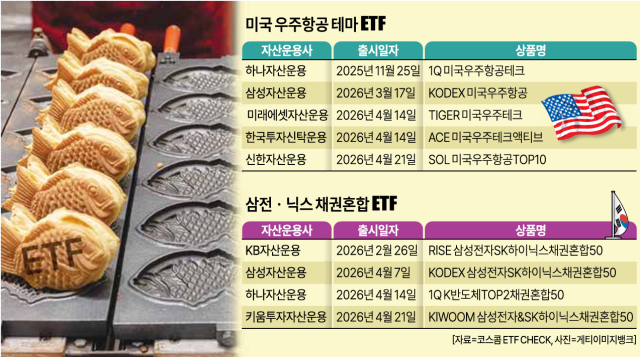
A prominent example is U.S. space and aerospace-themed ETFs. After Hana Asset Management launched “1Q U.S. Space Aerospace Tech” on Nov. 25 last year, the category has grown to five ETFs. Samsung Asset Management joined in March with “KODEX U.S. Space Aerospace.” On April 14, Mirae Asset Management and Korea Investment Trust Management launched “TIGER U.S. Space Tech” and “ACE U.S. Space Tech Active,” respectively. Shinhan Asset Management also introduced “SOL U.S. Space Aerospace TOP10,” promoting what it called an industry-low fee level. While details differ, the overall frameworks are largely similar.
The same pattern has emerged in so-called “Samsung Electronics-SK Hynix bond-mix” products, which allocate 25% each to Samsung Electronics and SK Hynix and the remaining 50% to bonds such as Korean Treasury bonds and Monetary Stabilization Bonds. After KB Asset Management launched “RISE Samsung Electronics SK Hynix Bond Mix 50” in February, Samsung Asset Management followed on April 7 with “KODEX Samsung Electronics SK Hynix Bond Mix 50.” Hana Asset Management launched “1Q K-Semiconductor TOP2 Bond Mix 50” on April 14, and Kiwoom Asset Management introduced “KIWOOM Samsung Electronics & SK Hynix Bond Mix 50” on April 21. With essentially the same asset-allocation structure, differentiation is limited.
◆ Protections that exist mostly on paper
Despite the spread of similar products, institutional safeguards have not taken hold. Protective mechanisms run by the Korea Exchange and the Korea Financial Investment Association have seen no applications or use for nearly five years, the report said. As a result, firms can design similar ETFs by making only minor adjustments to product structures. That has fueled the proliferation of look-alike funds, in contrast to the global ETF market, where managers build more differentiated lineups based on fee strategies, asset classes and management styles.
Industry officials and the organizations involved cite practical limits to granting exclusivity to any single ETF. ETF structures are rarely entirely new, and it is difficult to claim rights over the underlying constituent stocks. “If you adjust the weightings or bond duration, it is recognized as a different index, so it is not easy to control,” an industry official said.
Another issue is that index priority rights apply only within a narrow scope based on an index’s originality. KB Asset Management received six months of index priority rights after launching “RISE 200 Weekly Covered Call” in March 2024, with its approach recognized as distinctive for seeking extra returns by selling call options on the KOSPI 200. However, in December that year, Samsung Asset Management also received three months of index priority rights for “KODEX 200 Target Weekly Covered Call.” While both use a call-selling strategy, Samsung’s product set a target distribution rate and adjusted the option-selling ratio accordingly, presenting a partially different approach. That means a product can be treated as a separate index by modifying details while relying on the same underlying investment idea.
One asset management industry official said South Korea’s ETF market is still in a formative stage and could diversify over time into more distinctive offerings, as seen recently with the emergence of active-focused managers. The official said the current wave of copycat products may be a transitional phenomenon amid rapid growth.
* This article has been translated by AI.
Copyright ⓒ Aju Press All rights reserved.