

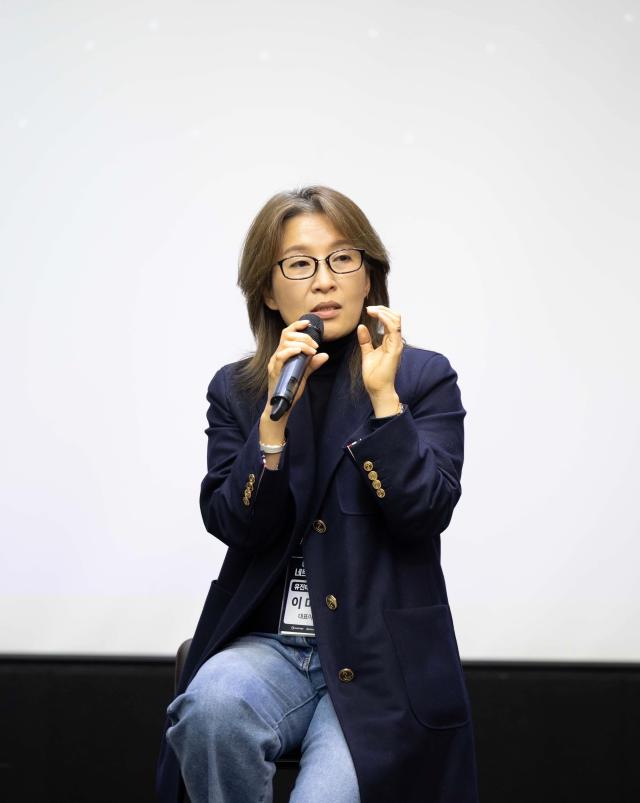
Lee Mi-yeon, chair of the Korea Battery Technicians Association, said maintaining Korea’s “super-gap” advantage will depend on building a field-centered talent ecosystem. “What will determine competitiveness is how many practical technicians we can secure who can be deployed immediately, not theory-focused talent,” she said.
In an interview Tuesday with Ajou Economy, Lee pointed to a workforce mismatch as the industry’s biggest problem. “The industry is growing fast, but the people needed on site are still in short supply,” she said, adding that companies repeatedly face inefficiency by hiring new workers and then retraining them because of a gap between education and workplace needs.
She said the profile of in-demand workers is changing. Where the focus once was on employees who could follow fixed processes precisely, plants now need “judgment-based technicians” who can diagnose and solve problems using data.
“The current education structure remains at ‘70% theory, 30% practice,’ but the field demands the opposite,” Lee said. “Without a shift to practice-centered training, the labor problem will continue.”
South Korean battery companies are already facing severe shortages. The Ministry of Trade, Industry and Energy and the Korea Battery Industry Association project domestic workforce demand in the secondary battery sector will rise rapidly and exceed 110,000 by 2032, implying that about 54,000 additional specialized workers will need to enter the industry.
But the number of battery-related graduates and job-ready workers produced each year remains only in the thousands, she said. Shortages extend beyond research and development to production staff who run processes and manage yield.
Global conditions are similar. The International Energy Agency said global energy-sector employment totaled 76 million in 2024, up more than 5 million from 2019. Jobs tied to electric vehicles and batteries led growth, increasing by about 800,000 in a single year.
Companies, however, are struggling to secure workers with practical skills. In an IEA survey of more than 400 global energy companies, more than half cited labor shortages as their biggest management risk.
Firms said their biggest hiring challenges were a lack of candidates with needed technical skills and intensifying competition for talent from rivals and other industries.
Lee said overseas production bases are expanding quickly, but core engineers who can set up sites and manage quality are “absolutely” in short supply. To run global production lines reliably, she said, Korean engineers who can train local workers and lead technical work are becoming more important.
She said plants are no longer looking for people who simply do what they are told. “The field wants technicians who make their own judgments and take responsibility,” Lee said, calling the ability to analyze battery conditions, interpret abnormal data and connect it to process improvements a key capability.
Lee said talent development is directly tied to global competitiveness. She said China is ahead in scale and growth speed, but Korea has strengths in precision processes, quality and safety standards. Korea should respond with a strategy centered on advanced engineers, not just production labor, she said.
The association focuses on training “immediately deployable” practical workers in batteries and electric-vehicle charging, including programs for specialized roles such as battery performance evaluators.
It has recently expanded and reorganized as the incorporated Korea Battery Technicians Association, moving to strengthen the credibility of its certification system and to build a technician career-history management system.
Lee said a key goal during her term is “standardizing technicians” by integrating differing company criteria and building a national standard curriculum and qualification system focused on diagnostics, evaluation and safety.
She said the association cannot solve the problem alone. “Battery diagnostic equipment and safety training facilities are too costly for the private sector to build on its own,” Lee said, calling for national-level infrastructure support. She added that qualifications such as battery performance evaluator should be institutionally linked and recognized so they can be used in actual hiring standards.
Lee also cited staffing shortages at regional manufacturing sites, saying the gap between the Seoul metropolitan area and other regions is widening and making it harder to secure skilled technicians.
She called for a workplace-linked education model involving regional universities, companies and the association to create a virtuous cycle from “education → employment → settlement,” alongside better treatment of technicians and a stronger career-management system.
“Ultimately, trust in an industry comes from people,” Lee said. “When trained technicians are sufficiently present on site, competitiveness can be maintained.”
She said this year should be a starting point for building national education standards and hands-on training infrastructure, adding that the association will take the lead in building a field-centered talent ecosystem to help sustain Korea’s battery advantage.
* This article has been translated by AI.
Copyright ⓒ Aju Press All rights reserved.