

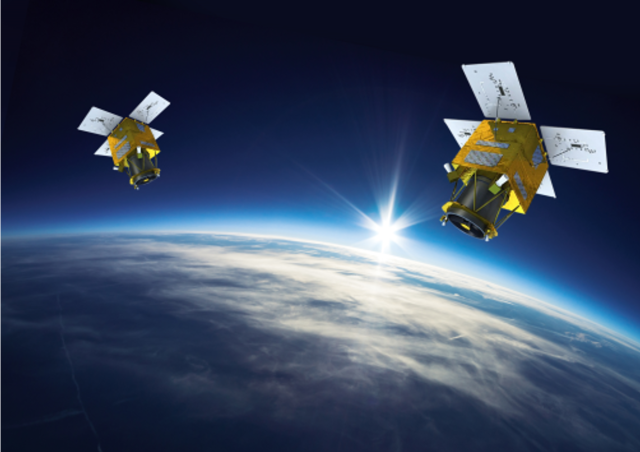
South Korea’s Next-Generation Medium Satellite 2 is set to head to space from Vandenberg Space Force Base in California aboard SpaceX’s Falcon 9 on May 2 local time.
The Korea Aerospace Administration said the satellite is scheduled for launch at 3:59 p.m. May 3 in South Korea (tentative).
According to the launch sequence, the Falcon 9 will shut down its first-stage engine 135 seconds after liftoff and ignite the second-stage engine 146 seconds after liftoff. The payload fairing is to separate at 182 seconds. Final separation of the satellite is planned at 3,625 seconds after launch, about 60 minutes 25 seconds.
After launch, the satellite is expected to settle into an orbit of about 498 kilometers (309 miles). It will undergo about four months of initial operations before beginning full mission work in the second half of 2026. The Korea Aerospace Research Institute (KARI) will conduct initial after-launch checks (IAC) and in-orbit tests (IOT). Ground stations for early operations will include King Sejong Station in Antarctica, Troll Station, Svalbard in Norway and a station in Daejeon.
Next-Generation Medium Satellite 2 is the first mid-size satellite independently developed under the lead of a South Korean industrial company. Korea Aerospace Industries (KAI) joined the design team for Next-Generation Medium Satellite 1 starting in 2015 and received transfers of key technologies, then led development of the second satellite.
The project began in January 2018 and proceeded in stages. It passed a system assembly test readiness review meeting (IRR) in June 2020 and completed a pre-shipment review (PSR) in December 2021.
The satellite was originally to be launched from Russia, but the launch was halted after the Russia-Ukraine war began in February 2022. In November 2023, South Korea ended the launch contract with the Russian side and selected SpaceX as the replacement provider, signing a new contract.
With the schedule delayed, the satellite underwent state-of-health (SOH) tests every six months while stored on the ground. It completed a final integration test in December and finished a second PSR in March. In April, it was transported to the launch site for final preparations.
The aerospace administration said the project is significant because the satellite bus and some core payloads were developed with domestic technology. “It verified Korea’s independent space development capabilities and laid the groundwork for follow-on satellites and international competitiveness,” the agency said.
The satellite’s mission is to support public needs such as land and resource management and disaster response. It will provide high-resolution imagery used for ground observation, change detection, mapmaking and urban planning, and can support damage assessment and response during disasters such as typhoons, floods and wildfires.
Separately, Next-Generation Medium Satellite 3 was launched on Nov. 27 from the Naro Space Center in Goheung, South Jeolla Province, on the fourth flight of South Korea’s Nuri rocket. That launch was the first produced under private-sector leadership and the first nighttime launch, successfully separating one primary payload and 12 secondary satellites.
Next-Generation Medium Satellite 3 observes auroras and airglow in high-latitude regions and precisely measures the space magnetic field and plasma environment. Full mission operations began in February.
* This article has been translated by AI.
Copyright ⓒ Aju Press All rights reserved.