

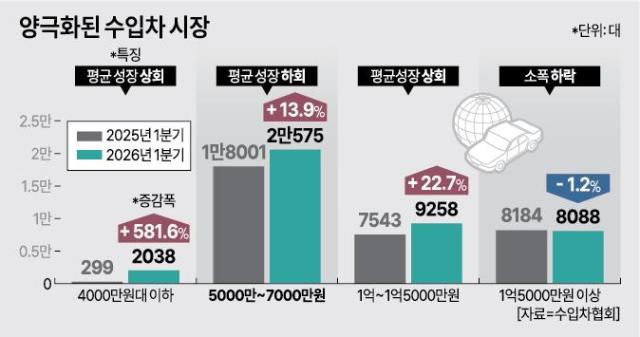
According to the Korea Automobile Importers & Distributors Association on May 3, sales of imported cars priced at 100 million won or more totaled 17,375 in the first quarter, up 13.3% from 15,795 a year earlier. By price band, vehicles priced from 100 million won to under 150 million won jumped 22.7% to 9,258. Sales of models priced at 150 million won or more edged down 1.2% to 8,088 from 8,184.
Among imported cars priced above 100 million won, BMW led with 6,540 vehicles sold, followed by Mercedes-Benz with 4,687 and Porsche with 2,105.
Among brands classified as “luxury cars,” Bentley sold 99 vehicles in the first quarter, up 98% from 50 a year earlier. Land Rover sales rose 10.1% to 1,141 from 1,036, and Rolls-Royce increased 13.2% to 43 from 38.
Budget-focused brands also gained ground. China’s BYD sold 2,252 vehicles in the first quarter, accounting for 84% of imported-car sales priced under 40 million won. With BYD’s surge, total sales in that under-40-million-won segment reached 2,038, up 581.6% from 299 a year earlier.
The split is also evident in EVs. Sales of imported EVs priced at 100 million won or more rose 72.3% to 2,872 in the first quarter. At the same time, sales of mass-market EVs priced at 50 million won or less totaled 17,938, about 60% of the overall imported EV market of 31,498, driving growth.
By contrast, sales in the 50 million to 70 million won range—often seen as the market’s average price band—rose 13.9% to 20,575. That increase lagged the overall imported-car growth rate of 35.5%.
The disappearance of midrange demand is being attributed to widening gaps in household wealth. With some assets such as real estate and stocks rising sharply, higher-income consumers have gained purchasing power, while many households facing high prices and high interest rates are focusing more strictly on value, the association said. The trend has been reinforced as EV brands such as Tesla reduce midpriced offerings and emphasize a two-track approach centered on higher-margin luxury models and lower-priced vehicles.
An industry official said the value segment is expanding as lower-priced EVs gain traction, while buyers seeking clear differentiation are moving into the ultra-premium market, reshaping demand toward the extremes. “Brands with an unclear position will find it increasingly difficult to survive,” the official said. The official added that as polarization by price is expected to become more pronounced, imported-car brands should refine strategies to meet layered consumer demand.
* This article has been translated by AI.
Copyright ⓒ Aju Press All rights reserved.