

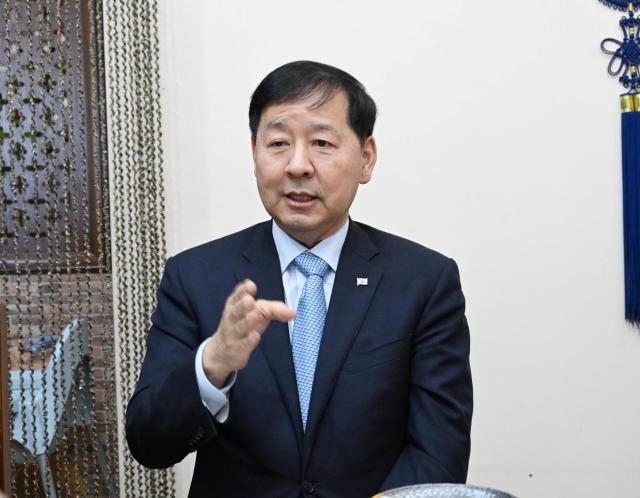
Deputy Prime Minister and Minister of Economy and Finance Koo Pyo-cheol said South Korea will hold to its 2% economic growth target this year despite the prolonged Middle East war, which he said is adding uncertainty and inflation pressure.
Koo made the remarks May 5 (local time) after attending the Asian Development Bank annual meeting in Samarkand, Uzbekistan, along with the ASEAN+3 finance ministers and central bank governors meeting.
“Because the Middle East situation is changing a lot, it is practically difficult to forecast growth, and the impact is large,” Koo said. “But I want to say we will achieve the 2% (growth) we originally promised.”
He added that investment banks’ forecasts are “much higher than 2%,” and said he told counterparts he would work closely with a new governor on policy cooperation to meet the goal.
On inflation measures drawing attention amid high oil prices, including a “maximum oil price system,” Koo said decisions on whether to maintain or end the policy depend on how quickly the Middle East war situation changes.
“The best policy is for the Middle East to move to a peace system,” he said. But with uncertainty and oil prices above $100, he said the government would need to respond with a combination of measures if prices stay elevated.
Koo said the government would watch inflation closely, citing the risk of broader price increases stemming from higher fuel taxes and rising diesel and gasoline prices.
He also said South Korea’s fiscal management and policy response are earning trust from international organizations. Koo said he met with the International Monetary Fund’s deputy managing director, who assessed South Korea as “doing very exemplary work.”
Koo said the IMF official spoke highly of South Korea repaying 1 trillion won without issuing government bonds because tax revenue conditions were favorable. He also said the official noted that even as oil prices surged 50% in the United States, South Korea has managed the situation steadily through policy coordination.
Asked about the possibility of a second supplementary budget, Koo was cautious. “Right now, we need to focus on executing the first supplementary budget,” he said, noting the government has already approved a 26.2 trillion won package and is prioritizing rapid implementation. He added that with the main budget near 730 trillion won, the focus is also on executing that spending.
On exchange-rate volatility, Koo said it is not appropriate to comment on specific levels because the market sets the rate. Still, he said the key factor for the exchange rate, inflation and growth is how quickly the Middle East war stabilizes.
If volatility persists, Koo said the government would respond actively with a policy mix and work closely with the Bank of Korea, the Financial Services Commission and the Office of Planning and Budget to prevent economic instability.
On the possibility of a currency swap with the United States, Koo said external changes, including a change in the Federal Reserve chair, mean the issue should be reviewed comprehensively, signaling a cautious stance.
* This article has been translated by AI.
Copyright ⓒ Aju Press All rights reserved.