

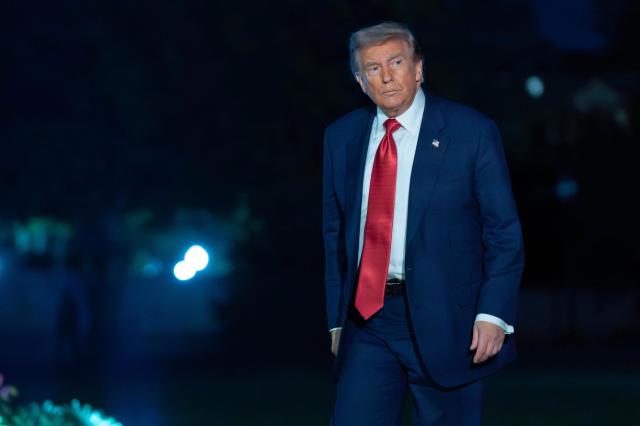
President Donald Trump has stated that he cannot accept Iran's response to the U.S. proposal for ending hostilities, while Iran has pushed back, asserting that its proposal was not intended to please the U.S. leader.
On May 10, Trump expressed his dissatisfaction via social media platform Truth Social, saying, "I just read the response from Iran's so-called 'representatives.' I do not like it. It is completely unacceptable." However, he did not specify which aspects of the Iranian response he found unacceptable.
Last week, the U.S. sent a proposal to Iran aimed at ending the conflict. Trump mentioned on May 8 that he expected to receive a letter that night, but Iranian state news agency IRNA reported on May 10 that Iran had communicated its response to the U.S. through the mediator, Pakistan.
Details of the Iranian response have been reported differently by various sources. The Wall Street Journal (WSJ), citing informed sources, reported that Iran proposed a ceasefire and a gradual resumption of commercial navigation in the Strait of Hormuz, while demanding the lifting of U.S. sanctions on Iranian vessels and ports.
In contrast, the Iranian semi-official Tasnim news agency disputed the WSJ's account, claiming that Iran's response emphasized an immediate end to the war, a guarantee against further U.S. attacks, the lifting of sanctions, and a cessation of hostilities across all fronts. The source also stated that the U.S. maritime blockade against Iran should end immediately following the initial agreement, and sanctions related to the sale of Iranian oil should be lifted within 30 days.
Additionally, Tasnim reported that Iran's response included demands for the release of frozen Iranian assets abroad and the implementation of certain U.S. measures within 30 days.
Iran: Proposal Not Written to Please Trump
Iran has reacted to Trump's rejection of its proposal. According to Tasnim, another informed source stated, "No one in Iran writes proposals to please Trump," asserting that the Iranian negotiating team bases its plans solely on the rights of the Iranian people. The source added that if Trump is not satisfied with Iran's proposal, "then that is certainly a good thing."
The source also claimed that Trump is refusing to accept reality, which is why he continues to face defeats in Iran.
Meanwhile, media outlets linked to the Islamic Revolutionary Guard Corps (IRGC) have suggested that the Strait of Hormuz should be utilized not only as an energy and shipping chokepoint but also as a digital leverage tool. Tasnim reported that over $10 trillion in financial transactions occur daily through undersea fiber optic cables in the Strait, asserting that Iran must secure economic and sovereign benefits from this infrastructure. They proposed imposing licensing fees and annual renewal fees on foreign companies and insisted that major tech firms operate in accordance with Iranian law.
Another IRGC-affiliated outlet, Fars News, echoed similar sentiments, stating that over 99% of international internet communications occur via undersea cables and that Iranian companies should manage the maintenance and repair of cables passing through the Strait. Fars noted that Iran could require permits and tolls for vessels passing through the Strait, thereby transforming it into a tool of digital power for Iran.
This indicates Iran's intention to impose tolls on vessels traversing the Strait of Hormuz while seeking additional revenue generation from this strategic waterway.
* This article has been translated by AI.
Copyright ⓒ Aju Press All rights reserved.