

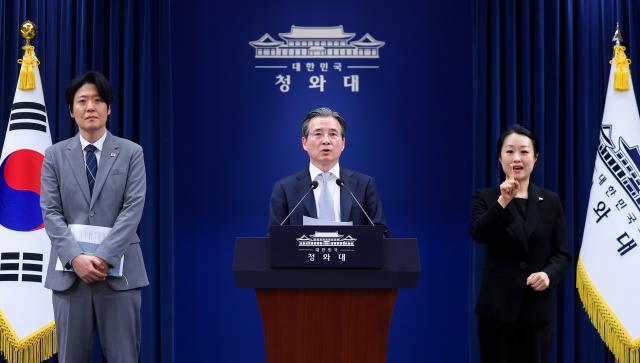
Presidential policy chief Kim Yong-beom argued in a social media post that the emerging AI boom was not created solely by individual firms, but by decades of national investment and collective economic development.
"The AI bonanza was not generated by certain companies alone," Kim wrote. "If strategic advantages in the AI infrastructure supply chain create a structural boom and unprecedented excess tax revenue, how to use that money wisely becomes a question society must deliberate."
The remarks come as South Korea's stock market has been increasingly dominated by AI-linked semiconductor giants Samsung Electronics and SK hynix. Samsung Electronics shares closed at 279,000 won on Tuesday, up about 384 percent from 57,600 won a year earlier, while SK hynix ended at 1,835,000 won, soaring roughly 841 percent from 195,000 won over the same period, underscoring how the AI-driven semiconductor rally has reshaped the country’s financial markets and broader economy.
Against that backdrop, Kim argued that profits generated from industries built on "the foundations the people have cultivated over the past half century" should be shared with the broader public through institutional mechanisms.
Kim warned that South Korea had squandered a similar opportunity during the semiconductor supercycle of 2021 and 2022, when large excess tax revenues were spent without long-term planning.
"The scale of this cycle could be incomparable to the previous one," he said. "Allowing it to pass in the same way would mean wasting a once-in-a-generation historic opportunity."
As a possible framework, Kim referenced Norway's sovereign wealth model, under which oil profits have been accumulated in a state-run fund since the 1990s and later used to support welfare and long-term fiscal stability.
"In Korea's case, I would tentatively call it a 'national dividend,'" he said.
Kim suggested the proceeds could be used for youth startup funding, rural basic-income programs, support for artists, expanded pension schemes or education and retraining programs designed for the AI transition era. He stressed that the final structure should emerge through broad public debate and social consensus.
"If excess tax revenue never materializes, the idea of a national dividend could remain unrealistic," he said. "But letting those excess profits simply dissipate without any guiding principles could be even more irresponsible."
Kim argued that the defining challenge of the AI era would not simply be generating economic growth, but managing how extraordinary profits become increasingly concentrated among dominant companies and higher-income groups.
He said using part of those gains to cushion the social costs of AI-driven economic transformation should not merely be viewed as redistribution, but as a way to preserve long-term economic and social stability.
Kim also suggested that if Korea successfully develops an institutional model for redistributing AI-era windfalls, it could eventually become a global reference point as governments worldwide grapple with the economic disruptions caused by artificial intelligence.
"Korea could become the first country to return excess profits from the AI era back to human life," he said. "The model we begin debating and building now could later become an international standard."
His remarks come as policymakers and economists globally intensify discussions over how AI-driven productivity gains may accelerate wealth concentration while reshaping labor markets and industrial structures.
Kim also cited comments by Demis Hassabis, who recently argued for the need to develop new economic frameworks suited to the AI era.
Earlier this month, Kim projected that Korea could post historically large tax revenues in 2026 and 2027 if the semiconductor and AI infrastructure boom extends through next year.

Copyright ⓒ Aju Press All rights reserved.
