

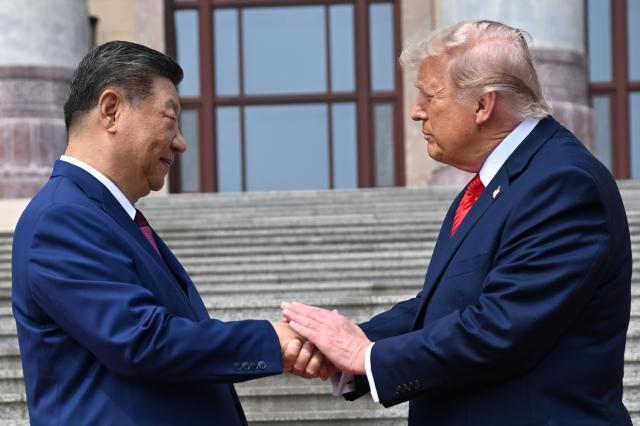
On May 14, 2026, the world turned its attention to the Temple of Heaven in Beijing as President Donald Trump and Chinese President Xi Jinping walked side by side. With few aides present and only interpreters accompanying them, the two leaders strolled slowly between the red walls and wet stone paths, creating a scene that transcended a mere diplomatic event. It symbolized a pivotal moment in the direction of 21st-century global order.
The meeting marked the first face-to-face encounter between the two leaders since the Asia-Pacific Economic Cooperation (APEC) summit in Busan last October, and it was Trump's first visit to Beijing in nearly nine years. The talks lasted approximately 135 minutes at the Great Hall of the People, followed by a walk in the Temple of Heaven, where Chinese emperors once offered sacrifices to the heavens.
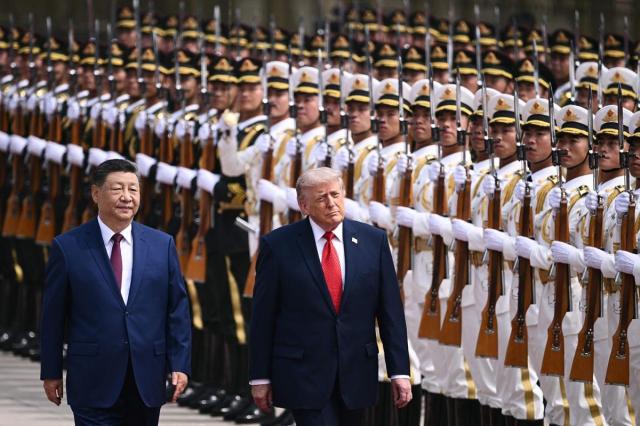
The meeting was visually impressive, featuring an official welcome ceremony, a military honor guard, national anthems, gun salutes, a red carpet, handshakes, and conversations, culminating in the stroll through the Temple of Heaven. However, beneath the surface, the discussions were serious. Topics included tariffs and trade, artificial intelligence and semiconductors, the Taiwan issue, Iran's nuclear program, the Strait of Hormuz, the Ukraine war, and the Korean Peninsula, essentially covering nearly every front of the global order.
Most importantly, the meeting demonstrated that despite being on the brink of confrontation, the United States and China still need each other. The relationship between the two nations is no longer simply one of hostility or cooperation; it is a structurally interdependent relationship where both countries can neither completely contain nor fully disengage from one another.
Language of Cooperation Amidst Competitive Realities
The official language of the meeting was one of cooperation. President Xi Jinping emphasized that the two nations should be partners rather than rivals, working together to achieve mutual success and shared prosperity. He proposed a new framework for U.S.-China relations termed a "constructive strategic stability relationship," which advocates for cooperation while managing competition and avoiding conflict.President Trump echoed similar sentiments, stating that the U.S. and China are the most important and powerful countries in the world and that cooperation between them could lead to significant achievements for both nations and the world. He referred to Xi as a "great leader" and expressed respect for the Chinese people. Trump also highlighted the presence of major American business leaders accompanying him, encouraging the expansion of business ties with China.
However, the essence of the summit lies more in its structural realities than in mere words. The U.S. cannot completely sever ties with China, nor can China abandon the U.S. market and technological ecosystem. The U.S. needs China's manufacturing capabilities and market, while China relies on U.S. advanced technology, financial systems, consumer markets, and global corporate networks. Thus, both nations must engage with each other while competing, applying pressure yet shaking hands, and preventing the collapse of the global economy. This Beijing summit was a reflection of that cold interdependence.
Symbolic Stroll at the Temple of Heaven
The most symbolic moment of the summit was the walk through the Temple of Heaven. This site is not merely a tourist attraction; it is where emperors of the Ming and Qing dynasties conducted rituals to confirm their divine mandate. In Chinese civilization, the concept of the mandate of heaven symbolizes the legitimacy of governance, the basis of order, and the fate of the nation.Xi's decision to take Trump to this location was not just a touristic gesture; it was a diplomatic statement reflecting China's self-perception as a successor to thousands of years of civilization, rather than just an economic power.
The U.S. is a relatively young republic, just over 250 years old, while China identifies itself as a 5,000-year-old civilization. The U.S. has historically influenced the world through its institutions, military power, dollar, and technology, while China seeks to reclaim its central position through its history, population, manufacturing, and national mobilization capabilities.
The fact that the two leaders walked together on the rain-soaked stone paths of the Temple of Heaven with only an interpreter present is also significant. While aides and protocol shape the dialogue in formal settings, it is in these moments of walking that the leaders' instincts collide. The stroll in the Temple of Heaven posed an unspoken question from China to Trump: "Will the U.S. view China merely as a competitor, or recognize it as a civilizational state with which it must manage the global order?"
The rain-soaked paths of the Temple of Heaven did not depict two civilizations standing under the same umbrella but rather two great powers with different timelines calculating a shared future.
Azaleas and Symbolic Diplomacy
At the center of the meeting venue were blooming azaleas. Chinese media interpreted the azaleas as symbols of prosperity, fortune, and optimism, with the mixed pink and white arrangement representing a harmonious future. China has historically conveyed messages through the arrangement of plants at meeting venues. During then-Secretary of State Antony Blinken's visit to China in 2023, lotuses were displayed, and in 2024, a plant arrangement symbolizing uncertainty drew attention.Chinese diplomacy speaks not only through words but also through visuals. The choice of location, flowers, colors, paths, protocol, meals, and walks all convey messages. The azaleas at this summit represented China's optimistic portrayal that the U.S. and China could choose harmony over conflict.
However, the beauty of the flowers does not erase the harsh realities of geopolitics. In fact, the more beautiful the flowers at the meeting venue, the harsher the underlying realities may be. While the azaleas symbolize prosperity and optimism, the actual U.S.-China relationship embodies both prosperity and distrust.
Thucydides Trap: A Question from Xi Jinping
During his opening remarks at the summit, President Xi Jinping revisited the concept of the "Thucydides Trap." This concept refers to the idea that an established power may feel threatened by the rise of a new power, leading to competition and potentially conflict. Xi warned that mishandling the Taiwan issue could lead to confrontation or disputes between the U.S. and China, jeopardizing their relationship.Xi's mention of this concept was no coincidence. China has long proposed a "new type of great power relations" to the U.S., which centers on the recognition of China's rise by the U.S., while China avoids direct confrontation and both nations manage the Pacific and global order together.
In simpler terms, China is essentially telling the U.S., "Do not contain us; recognize us as a G2." However, the likelihood of the U.S. accepting this outright is low. Acknowledging China as a co-manager of the global order would require the U.S. to relinquish part of its status as the sole hegemon. Conversely, if the U.S. continues to contain China, China will accelerate its self-reliance, supply chain independence, internationalization of the yuan, and military expansion. This point represents a dangerous crossroads for today's world.
Trump's Realism and a Changing America
Interestingly, President Trump's demeanor during the meeting was notably different. In the past, he had aggressively pressured China, employing tariffs, technology restrictions, and supply chain separation as hallmarks of his China policy. However, at this Beijing summit, he exhibited a more pragmatic attitude. He referred to Xi as a "great leader" and stated that the U.S. and China are the most important and powerful nations in the world.What accounts for this change? The answer lies in the realities facing the U.S. Currently, the U.S. is managing multiple fronts simultaneously: the war in Ukraine, crises in Iran and the Middle East, efforts to contain China, domestic political conflicts, and financial burdens. While the U.S. projects strength, its financial and industrial capacity to manage all fronts perfectly is not what it once was.
In the competition for artificial intelligence dominance, the U.S. excels in design and platforms but still relies on Asia for its manufacturing supply chain. Ultimately, the U.S. has begun to acknowledge the reality that complete decoupling from China is difficult.
Concrete Agreements on Iran and Hormuz
The most concrete agreements reached during the summit pertained to Iran and the Strait of Hormuz. The White House stated that the two leaders agreed that Iran should not acquire nuclear weapons and that the Strait of Hormuz must remain open for the free flow of global energy. They also confirmed their opposition to the militarization of the Strait and any attempts to impose tolls on its passage.This aspect is crucial. While the U.S. and China may clash over Taiwan and semiconductors, they share mutual interests in energy maritime routes. China is one of the world's largest energy importers. A blockade of the Strait of Hormuz would impact the U.S. as well, but it would be particularly devastating for China, which heavily relies on Middle Eastern oil. Therefore, the free passage through Hormuz is a key condition for China's economic stability.
Notably, the White House also highlighted Xi's interest in increasing purchases of U.S. oil to reduce China's dependence on Hormuz, which could serve as a buffer to ease U.S.-China tensions if realized.
However, this does not signify a strategic reconciliation. A more accurate term would be "selective cooperation." The two nations manage the potential for conflict over Taiwan while fiercely competing in semiconductors, yet they confirm shared interests regarding Iran and Hormuz. This may represent the operational reality of the new G2 era.
Taiwan Issue Remains a Deep Divide
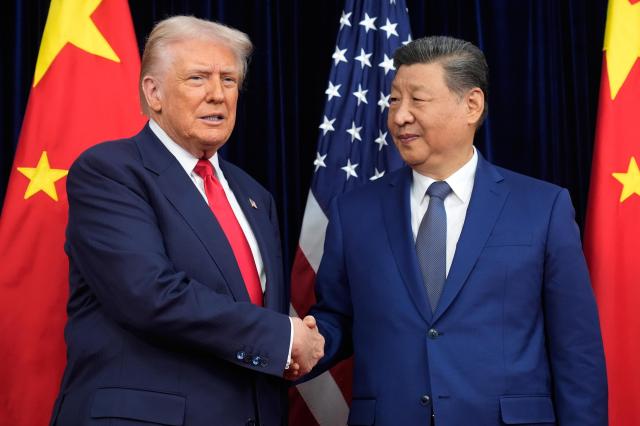
The Taiwan issue continues to be the most dangerous flashpoint. President Xi emphasized that the Taiwan issue is the most critical matter in U.S.-China relations. He warned that while proper handling could stabilize relations, mishandling could lead to conflict or disputes, endangering the entire U.S.-China relationship. Although Trump praised the meeting as "excellent," he did not respond to questions about discussions on Taiwan.This silence is significant. It could indicate avoidance, but it may also represent a strategic reserve. The U.S. cannot abandon Taiwan, yet it also does not desire direct confrontation with China. China can postpone addressing the Taiwan issue, but it cannot fold it indefinitely. Ultimately, the Taiwan issue was not resolved at this summit; it was merely sealed for the time being.
If the Strait of Hormuz is the heart of energy, the Taiwan Strait is the heart of semiconductors and supply chains. The region is crucial for the global advanced semiconductor supply chain and Northeast Asian maritime routes. A military conflict in the Taiwan Strait would not only affect China and Taiwan; it would simultaneously disrupt South Korean exports, Japanese industries, American tech companies, and the global financial market.
Semiconductor War Swallows Tariff Conflict
Another key aspect of this visit was the presence of American business leaders. Jensen Huang of NVIDIA and Tim Cook of Apple were among the prominent figures who accompanied Trump to Beijing, where he encouraged them to expand cooperation with China. This was not merely an economic delegation; it underscored that the sharpest front in U.S.-China tensions has shifted from tariffs to semiconductors and artificial intelligence.In the past, tariffs symbolized U.S.-China conflict. The trade war during Trump's first term revolved around tariff rates, trade deficits, and agricultural purchase commitments. However, the current focus is on chips—artificial intelligence chips, graphics processing units, high-bandwidth memory, advanced equipment, and data centers have become the new battleground.
NVIDIA represents the symbol of U.S. technological hegemony, while Apple illustrates the deep entanglement between China's manufacturing ecosystem and the U.S. consumer economy. Their presence indicates that Trump views this summit not merely as a diplomatic event but as a platform for technology, market, and supply chain negotiations.
The U.S. cannot completely cut off access to the Chinese market for its companies while restricting advanced chips to China. Conversely, China desires U.S. chips while simultaneously accelerating its domestic production. Sanctions and trade, pressure and dependence, restrictions and markets are all in motion simultaneously. This is the current semiconductor war.
Conclusion: Rain at the Temple of Heaven, Azaleas, and a New World Order
The rain at the Temple of Heaven was not merely a weather phenomenon. The azaleas at the center of the meeting were not just decorative. The rain symbolized the transition of the global order into a new season, while the azaleas represented China's message of prosperity and harmony amidst conflict.However, history does not move solely based on the language of flowers. Hegemony cannot be conceded through words, and civilizations do not reconcile overnight. The U.S. and China will continue to cooperate and compete, sometimes needing each other and at other times fearing one another.
The significance of the Beijing summit lies in this reality. The U.S. can no longer ignore China, and China cannot overlook the catastrophic consequences of a confrontation with the U.S. Both nations dream of a shared world but envision different futures.
Yet that world is singular. On the rain-soaked paths of the Temple of Heaven, Trump and Xi walked with differing timelines of civilization. One speaks of making America great again, while the other speaks of the great rejuvenation of the Chinese nation. The question remains whether these two visions will clash or coexist. The answer has yet to be written. However, the Temple of Heaven in Beijing on May 14, 2026, left one clear scene: the two great powers of the world can pause at the brink of war to engage in dialogue. Whether that dialogue marks the beginning of a new order or merely a prelude to postponed conflict depends on future choices.
* This article has been translated by AI.
Copyright ⓒ Aju Press All rights reserved.