

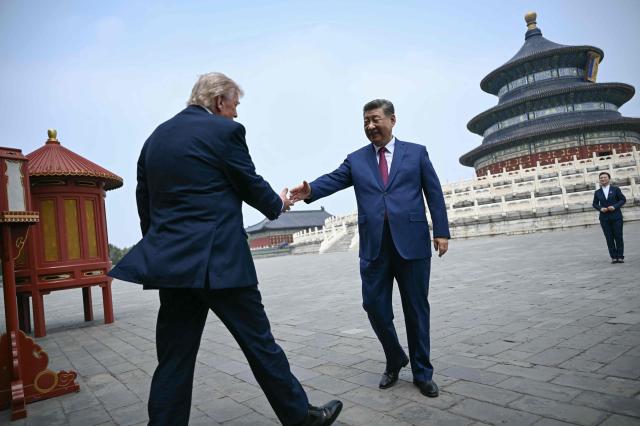
The summit between U.S. President Donald Trump and Chinese President Xi Jinping in Beijing in May 2026 transcended mere bilateral relations, impacting the geopolitical landscape of the Middle East and global energy order. The primary focus of the meeting was the Iran nuclear issue and the reopening of the Hormuz Strait.
According to a White House statement, both leaders agreed on the principle that “Iran must never possess nuclear weapons” and that “the Hormuz Strait must remain open for international energy supply.” Following the summit, President Trump emphasized that “President Xi also desires the reopening of the Hormuz Strait and is willing to assist in resolving the Iran issue.”
On the surface, this appears to be a significant diplomatic advancement. However, a closer examination of the messages from both the U.S. and China reveals a more complex reality. While the U.S. strongly emphasized “zero tolerance for Iran’s nuclear ambitions” and “full reopening of the Hormuz Strait,” China maintained a cautious stance. The Chinese Foreign Ministry confirmed that the Middle East issue was on the summit agenda but did not officially mention the U.S. emphasis on “zero tolerance for Iranian nuclear weapons.” Regarding the Hormuz Strait, China’s position remained at a general level, stating that “China’s stance is consistent and clear.”
This subtle difference in tone illustrates that while the U.S. and China sat at the same table, they are pursuing fundamentally different strategic calculations. For the U.S., the Hormuz Strait is not just another waterway in the Middle East; it is the heart of the global energy supply chain, influencing international oil prices, global inflation, maritime logistics, and financial market stability. The ongoing conflict in Iran has led to rising oil prices and inflationary pressures in the U.S., posing direct challenges for the Trump administration ahead of the midterm elections. Therefore, managing tensions in the Middle East is crucial for the U.S.
A key variable in this process is China’s influence over Iran. As one of the world’s largest oil importers and a major buyer of Iranian crude, the U.S. hopes China will exert pressure on Iran to ease tensions in the Hormuz Strait. Reports indicate that during the summit, President Xi expressed interest in increasing imports of U.S. oil and LNG. This is not merely an energy transaction; China aims to diversify its dependence on the Hormuz Strait while securing leverage in economic negotiations with the U.S. Expanding imports of U.S. energy could serve as a stabilizing factor in U.S.-China trade tensions.
However, the likelihood of China acting to the extent desired by the U.S. remains low. The relationship between China and Iran extends beyond simple oil transactions to a strategic partnership. Historically, the ties between the two nations run deep, dating back to the ancient Silk Road, which connected civilizations, commerce, religion, and culture across Eurasia. The Silk Road, which linked Chang'an to Persia, was not just a trade route but a vital artery of civilization. Today, China reinterprets this as its modern Silk Road initiative, the Belt and Road Initiative, with Iran as a key component. Geographically, Iran serves as a strategic gateway connecting the Middle East, Central Asia, Russia, and Europe. For China, Iran is an essential partner to reduce reliance on U.S. naval dominance and expand land-based supply chains.
The two countries have significantly strengthened their cooperation in energy, infrastructure, finance, and military sectors through a 25-year strategic cooperation agreement signed in 2021. China is effectively the largest customer for Iranian oil, while Iran continues to survive economically amid U.S. sanctions thanks to Chinese technology and capital. In essence, China has filled the void left by Western capital due to U.S. sanctions.
Energy cooperation is particularly critical. The Chinese economy relies heavily on vast oil and LNG consumption, with a significant portion of its oil imports coming from the Middle East, primarily through the Hormuz Strait. In other words, the Hormuz Strait is a lifeline for China’s industrial economy.
Thus, China does not desire a complete blockade of the Hormuz Strait either. The question remains: what form of reopening does China seek? The U.S. advocates for a complete freedom of navigation system under international law, while Iran aims to allow limited and selective passage under its security control. Recently, Iran has permitted certain friendly nations, including China, to navigate under specific conditions. This is not merely maritime control; Iran seeks to establish new geopolitical influence through the Hormuz Strait, applying pressure on vessels linked to the U.S. and Israel while allowing limited passage for China and some allies, thereby attempting to reshape the international order in its favor.
From China’s perspective, this structure is not entirely disadvantageous. A weakened U.S.-centric order in the Middle East could allow China to expand its strategic space. Ultimately, the Xi administration appears to be employing a complex strategy of cooperating with the U.S. while simultaneously maintaining its strategic relationship with Iran. This is why, despite the announcements from the U.S.-China summit, the actual situation remains uncertain. Attacks on vessels and incidents of seizure continue in the Hormuz Strait. An Indian cargo ship has been attacked and sunk, and there have been incidents of vessel seizures near the UAE. The international shipping industry is on high alert, with insurance premiums and freight rates soaring.
The global energy market is also unstable. The Hormuz Strait is a crucial corridor for global oil maritime traffic. If current tensions persist or escalate into military conflict, international oil prices could surge again, potentially reigniting inflationary pressures in the U.S. and Europe and posing serious challenges to the growth of Asian manufacturing countries like South Korea, China, and Japan.
So, is a peace negotiation between the U.S. and Iran possible? Currently, there is potential for limited ceasefires or partial de-escalation. However, numerous obstacles remain before full normalization of relations can occur. Iran has already secured a powerful strategic card in the Hormuz Strait through this conflict. Meanwhile, the U.S. seeks stability in the Middle East but cannot tolerate Iran’s nuclear development and regional hegemony. Ultimately, the future order in the Middle East is likely to be shaped by a complex balance of power involving the U.S., China, Iran, Saudi Arabia, Israel, and Russia.
The U.S.-China summit in Beijing symbolized both nations’ preference for manageable tensions over direct confrontation on this vast geopolitical chessboard. However, challenges remain. There is will, but trust is still lacking. The most dangerous moments in international politics arise when the gap between these two factors widens.
* This article has been translated by AI.
Copyright ⓒ Aju Press All rights reserved.