

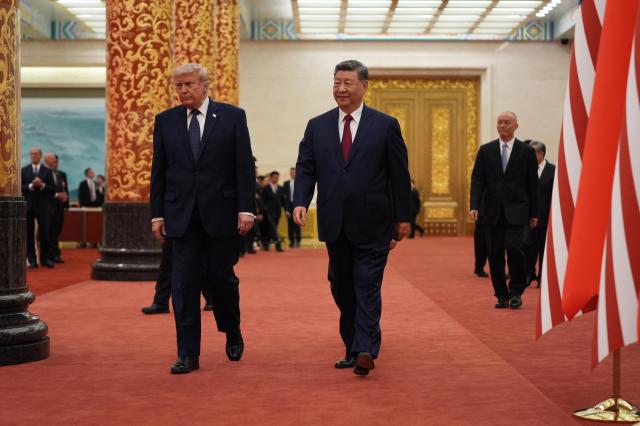
Japanese media reported that while U.S. President Donald Trump and Chinese President Xi Jinping avoided direct conflict during their recent summit in Beijing, tensions surrounding Taiwan have intensified. Trump suggested that arms sales to Taiwan could be used as a bargaining chip in negotiations with China, raising concerns that the U.S. commitment to Taiwan's defense may be wavering. Although both nations publicly advocate for 'stability,' Japan perceives the situation as an 'unstable stability' influenced by Taiwan, supply chains, and U.S.-China transactions.
Asahi Shimbun highlighted Trump's remarks during a Fox News interview on May 16, where he stated that Taiwan arms sales depend on China and described them as “very good negotiation material.” He avoided giving a definitive answer on whether he would approve arms sales, saying, “We could do it, or we could not.” Asahi noted that this statement could undermine the longstanding U.S. practice of not consulting China prior to arms sales to Taiwan.
Asahi particularly pointed out the 'Six Assurances' established by the Reagan administration in 1982, one of which stipulates that the U.S. would not consult China regarding arms sales to Taiwan. This has been a key aspect of U.S. policy toward Taiwan. However, Trump indicated that he does not regard this practice as significant, stating, “The 1980s was quite a long time ago.” If arms sales to Taiwan become a bargaining tool with China, it could raise questions about the U.S. commitment to Taiwan's security.
Nikkei also reported on May 17 that while the U.S. and China presented a 'constructive strategic stability relationship,' the Taiwan issue remains a major flashpoint. The stability that China refers to is predicated on the U.S. respecting its stance on Taiwan. Xi warned during the summit that mishandling the Taiwan issue could lead to confrontation and put U.S.-China relations in a precarious position. Nikkei noted that Trump’s mention of using Taiwan arms sales as a negotiation card could provoke a backlash from China if implemented, while withholding sales could heighten anxiety in Taiwan and Japan, keeping the Taiwan issue as a significant destabilizing factor in U.S.-China relations.
Japanese media focused more on the underlying implications of the U.S.-China summit rather than its immediate outcomes. Asahi described the meeting as an example of “unstable stability.” While both countries avoided direct confrontation over tariffs and export regulations, this was interpreted not as a resolution of conflicts but as a result of mutual dependence on each other’s vulnerabilities, such as rare earth elements and advanced technology. Asahi likened this to the détente of the Cold War era, noting that history shows such arrangements can be fragile.
Yomiuri Shimbun also assessed that the tangible outcomes of the summit were limited. Trump emphasized a “great trade deal,” but specifics were confined to increased soybean imports from China and orders for Boeing aircraft. Yomiuri highlighted Trump’s display of personal rapport with Xi, noting that after a stroll in the Zhongnanhai gardens, Trump remarked, “We have really gotten close,” underscoring the strengthening of ties between the two leaders.
Particularly concerning for Yomiuri was Trump’s reference to a 'G2' (Group of Two) dynamic, calling the U.S. and China “two great countries.” This terminology could imply an equal status for the U.S. and China as superpowers, raising concerns that Trump may be pursuing an international order prioritizing national interests alongside Xi. This has led to fears that Japan’s interests may not be adequately represented in potential U.S.-China negotiations.
There are also analyses suggesting that China aims to buy time through this summit. Yomiuri posited that China seeks to delay confrontations with the Trump administration while securing time to recover from its real estate slump and sluggish consumption. Asahi noted that while China agreed to low-level demands such as increasing purchases of U.S. products, it avoided making concrete commitments on issues like the situation in Iran, indicating that the summit was largely conducted on China’s terms. Asahi reported a growing confidence within China that it can negotiate on equal footing with the U.S.
This trend poses challenges for Japan as well. Asahi pointed out that while leaders and business figures from various countries, including the U.S., are engaging with China, Japan's relations with China have cooled to the point of a breakdown in dialogue. There are concerns that Japan may be sidelined in both diplomatic and economic spheres as the U.S. and China strengthen their ties. The potential for the U.S. to negotiate with China over Taiwan, the timing of U.S.-China interactions regarding supply chains, and Trump’s G2-style diplomacy could all limit Japan’s options.
Major Japanese media do not view the U.S.-China summit as merely a step toward improving relations. While both countries have clearly decided to avoid reigniting a trade war and continue dialogue, this stability rests on precarious factors such as the Taiwan issue, supply chain dependencies, China’s strategy to buy time, and Trump’s transactional diplomacy. In particular, if Taiwan arms sales are treated as a bargaining chip in negotiations with China, the stability of U.S.-China relations could mark the beginning of new instability for security in East Asia, a point emphasized by major Japanese outlets.
* This article has been translated by AI.
Copyright ⓒ Aju Press All rights reserved.