

Global attention is focused on an experiment by a prominent physical artificial intelligence (AI) startup, which aims to demonstrate that humanoid robots can replace human labor in manufacturing and logistics. As competition in physical AI technology intensifies among major countries, experts warn that South Korea has limited time to secure a leading position.
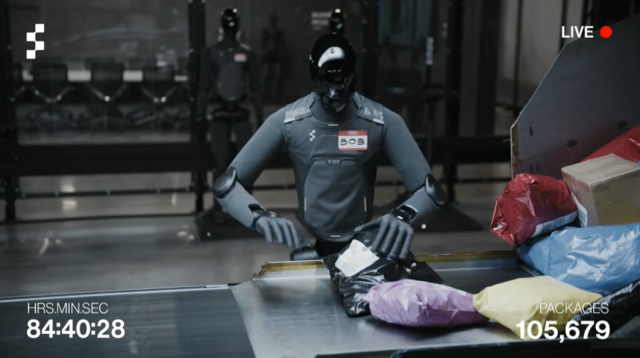
According to industry sources, FigureAI, recognized as one of the top three humanoid robot companies alongside Tesla and Boston Dynamics (a Hyundai Motor Group subsidiary), has been conducting an experiment since May 13, 2026, to perform logistics sorting tasks solely with robots, without human intervention.
The humanoids at FigureAI have worked continuously for 24 hours, sorting over 100,000 packages in 82 hours. Three robots, named Gary, Bob, and Rose, operated in shifts, working for 8 to 20 hours before undergoing charging and maintenance before returning to work.
The duration of the experiment remains uncertain. Brett Adcock, CEO of FigureAI, stated on social media platform X, "We plan to run them until they break down. Watch the robots work autonomously 24/7." Adcock also mentioned plans for a future project comparing efficiency between humans and robots in the same tasks.
However, some shortcomings have been noted. The robots achieved only half the efficiency of skilled human workers and occasionally dropped items during sorting. Nevertheless, experts have expressed astonishment at the level of physical AI technology in the U.S., noting that the robots performed naturally in a real working environment, not just in a lab setting. They do not take breaks for meals or smoking, and notably, they do not strike.
The implications of this experiment are expected to be significant, comparable to the historic Go match between Lee Sedol and AlphaGo. It confirms the potential for physical AI and humanoid robot technology to replace blue-collar jobs. As the U.S. and China lead the physical AI competition, the need for the South Korean government and businesses to unite in enhancing technological competitiveness and accelerating commercialization has become increasingly urgent.
* This article has been translated by AI.
Copyright ⓒ Aju Press All rights reserved.