

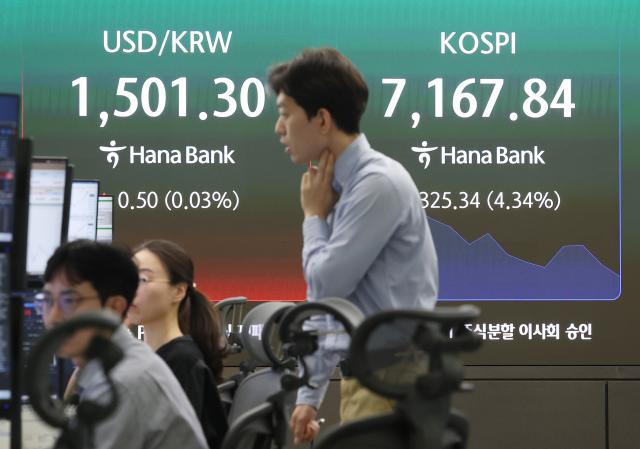
The won-dollar exchange rate remains above 1500 won amid rising global government bond yields.
As of 9:28 a.m. on May 18 in the Seoul foreign exchange market, the exchange rate stood at 1501.0 won per dollar, opening at 1501.2 won, an increase of 0.4 won from the previous trading day.
The rise in global interest rates appears to have dampened the appetite for riskier assets. On May 15, yields on government bonds in major countries, including the United States, the United Kingdom, and Japan, surged to their highest levels in decades.
On this day, the yield on the 10-year U.S. Treasury rose by 13.8 basis points to 4.597%. The yield on the 30-year U.S. Treasury reached 5.12%, the highest level since July 2007.
The yield on the UK 10-year government bond briefly exceeded 5.18%, while the 30-year bond yield surpassed 5.86%, marking the highest levels in decades. Similarly, the yield on Japan's 10-year government bond rose to the 2.7% range, the highest since 1997.
Concerns are growing that inflation shocks from the ongoing conflict in the Middle East could persist, contributing to rising bond yields. As risk aversion increases, foreign investors have been net sellers in the securities market, offloading 694.7 billion won in the early trading session.
Min Kyung-won, an economist at Woori Bank, stated, "The rise in global government bond yields, sparked by renewed inflation concerns, inevitably adds pressure to stock market valuations. The accelerated outflow of foreign capital from the KOSPI will likely heighten upward pressure on the exchange rate due to some reverse remittances and speculative long positions offshore."
* This article has been translated by AI.
Copyright ⓒ Aju Press All rights reserved.