

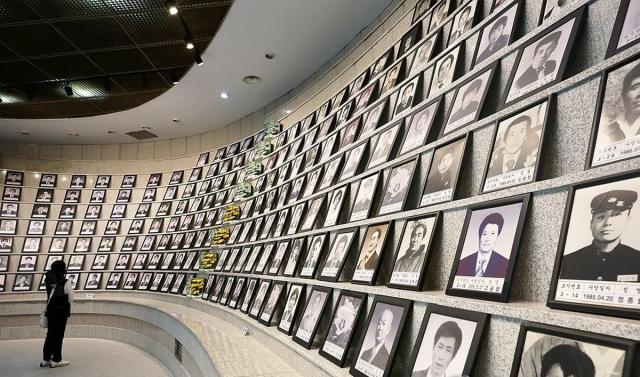
The 46th anniversary of the May 18 Democratic Movement was commemorated once again in Gwangju, at Geumnam-ro and in front of the former Jeonnam Provincial Office.
Forty-six years have passed since the tragic events of May 18. This movement is no longer just a source of pain for a specific region or a political controversy. It has become the root of democracy in South Korea and a historical account of the people's resistance to state violence in defense of human dignity and freedom.
However, history is not completed by memory alone. The true completion of history lies in reconciliation and forgiveness. The tragedy of Gwangju is not yet fully resolved. The wounds of the victims' families remain fresh, and those who held power at the time have yet to fully confront their responsibilities before history. What South Korea needs now is not another cycle of hatred or political exploitation, but a sincere repentance and a commitment to restore human dignity.
This symbolic journey must begin with a heartfelt apology from those responsible for the violence. In particular, the families of former President Chun Doo-hwan and other key figures from that era should eventually visit Gwangju together. This is not about a political event; it requires a humble acknowledgment of the historical wounds as human beings. Paying respects at the National May 18 Democratic Cemetery and apologizing before the spirits of the victims is not merely about addressing the past. It can serve as a historical consciousness for South Korea to break the cycle of hatred and move toward becoming a mature democratic nation.
At the same time, the families of the victims and civil society in Gwangju must also contemplate a greater commitment. This is not about forgetting but about forgiving. Forgiveness without truth is hollow, but a history without forgiveness makes it difficult to move forward. Ultimately, the ultimate goal of democracy is not revenge but the restoration of the dignity of human life.
The great scriptures of humanity have all taught the dignity of life and reconciliation. The Bible says, “Love your enemies.” “Those who live by the sword will die by the sword.” The Dhammapada teaches, “Hatred cannot be overcome by hatred; only love can do that.” In the Analects, Confucius states, “One must overcome resentment with virtue.” The Tao Te Ching also says, “The strong do not last, but the gentle ultimately prevail.”
In the end, the great spirit of human civilization converges into one. Power that disregards human life does not endure, and history ultimately sides with those who sought to protect life.
In this regard, the tragedy of May 1980 stands as one of the greatest lessons in modern Korean history. The moment state power treats the lives of its citizens lightly, it loses its legitimacy. The fundamental purpose of politics is not to maintain power but to protect human life and uphold the dignity of the people.
Thus, May 18 is not merely a democratic movement but also a 'history of respecting life.' Even amidst gunfire, citizens tried to save one another, shared rice balls, and lined up in front of blood donation vehicles for the injured. The essence of Gwangju was not hatred but humanity.
Today, South Korea stands once again at a crucial crossroads. Political polarization has reached extremes, and language that defines each other as enemies is rampant. However, if Gwangju is truly the sacred ground of South Korean democracy, it must now move beyond the memories of hatred to embrace the spirit of reconciliation and forgiveness.
Of course, this is not an easy task. Reconciliation without a genuine apology can become hypocrisy. Therefore, what is first needed is the sincerity of those responsible for the violence. It must not be a mere show of respect or a formal apology; it should be a humble kneeling before the sanctity of human life. Only when the families of the victims and the citizens of Gwangju can make a historic, grand decision on this foundation will South Korea finally be recorded as a nation that has completely overcome May 18.
Even Chun Doo-hwan, a former president who once dominated an era, is said to remain unburied, existing only in a state of ashes. This is not just a personal tragedy; it symbolizes the fate of power that disregarded human life throughout history.
Hatred begets more hatred. However, forgiveness ends the cycle of historical evil. The May of Gwangju now poses a higher question to South Korea: Can we truly transcend hatred? Can we build a new community on the dignity of human life? Only at the end of that path will May 18 be truly completed as the spirit of South Korea.
* This article has been translated by AI.
Copyright ⓒ Aju Press All rights reserved.