

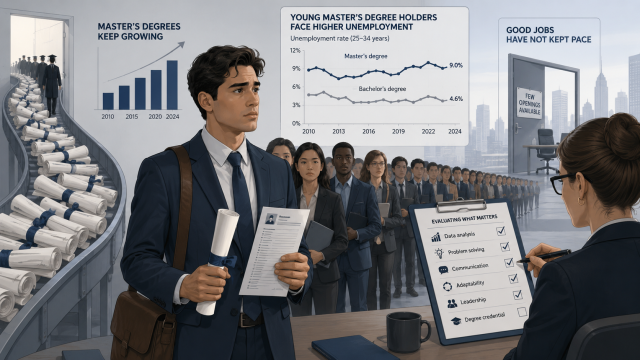
The employment premium associated with master's degrees in the United States is diminishing. While the number of master's programs has rapidly increased, the quality job opportunities that these degrees were expected to provide have not kept pace. Companies are increasingly prioritizing practical skills over academic qualifications in their hiring processes.
According to a report by the Wall Street Journal on May 17, labor market research firm Burning Glass Institute analyzed data from the U.S. Bureau of Labor Statistics (BLS) since 2003 and found that the unemployment rate for master's degree holders under 35 has reached one of its highest levels in the past two decades. In contrast, the unemployment rates for those with doctoral, law, or medical degrees in the same age group remain low.
Gad Levanon, chief economist at Burning Glass Institute, attributed the weakening investment return of master's degrees to an oversupply of graduates compared to the available jobs. He noted that while employment trends for advanced degree holders used to move in tandem, a widening gap has emerged between master's and professional degrees.
The supply of master's degrees has surged significantly. A report from the Center for Education and the Workforce indicates that the number of master's programs in the U.S. increased by 69% from 2005 to 2021, surpassing 33,500. In the past five years, there has been a rise in programs aimed at retraining for artificial intelligence (AI), including specialized one-year courses in online MBA, data science, and healthcare management.
The disparity arises from how degrees function in the job market. Medical and law degrees often lead directly to licensure, while master's degrees serve more as a 'signal' of capability. As the number of master's degree holders increases, the rarity of this signal diminishes. Levanon stated, "A master's degree is no longer a guaranteed pathway to good jobs."
In fact, the employment situation for master's degree holders under 35 has worsened compared to the average over the past 20 years. The Wall Street Journal reported that the unemployment rate for this group was only higher during specific periods, such as the COVID-19 pandemic and shortly after the 2008-2009 financial crisis. In the past year, the employment rate for those with associate degrees has been higher than that of master's degree holders.
Corporate hiring attitudes are also shifting. A survey from Drexel University's LeBow College of Business found that over 40% of companies reported no plans to hire MBA graduates this year, a significant increase from 26.8% last year. Johnny Taylor Jr., president of the Society for Human Resource Management (SHRM), noted that the rise of AI has led companies to focus more directly on job performance capabilities rather than degrees.
However, the utility of a master's degree has not completely vanished. Amir Zelcher, who is enrolled in the MBA program at Texas A&M University, is set to begin a full-time position at Texas Instruments this fall. He credited the school's career preparation program and support for interviews and salary negotiations as beneficial for his job search. The effectiveness of the degree now hinges more on the demand for the major, the school's career support, and actual job skills.
* This article has been translated by AI.
Copyright ⓒ Aju Press All rights reserved.