

Japan has long faced peculiar restrictions on the military equipment it can export. Despite possessing advanced capabilities, the country was limited to selling products for non-combat purposes such as structure, transport, surveillance, and mine clearance. This effectively meant that weapons could not be sold. However, the Japanese government recently revised its operational guidelines for the "Three Principles on Transfer of Defense Equipment," easing these restrictions. With case-by-case reviews, Japan can now export finished products with lethal capabilities. As South Korea's defense industry rapidly expands, Japan's long-dormant defense sector is beginning to awaken.
The Center for Strategic and International Studies (CSIS), a U.S. think tank, views this move as a significant change for Japan's defense industry to enter the global market. However, it cautions that regulatory relaxation does not automatically lead to international competitiveness. Japanese companies must demonstrate a willingness to compete in overseas markets, supported by government initiatives for sales, joint development, and technology transfer. Additionally, Japan lacks major defense contractors like the U.S. firm Lockheed Martin, and even large manufacturers such as Mitsubishi Heavy Industries have a minimal focus on defense, making large-scale investments or business expansions challenging. While the regulatory barriers have been lifted, securing competitiveness remains a separate issue.
The difficulty in transforming Japan's defense industry into an export sector stems from its long-standing market structure. For decades, the Self-Defense Forces were the sole customer for Japanese defense companies. With exports restricted, there was no opportunity to distribute development costs through bulk sales to allied nations like U.S. or European firms. Even when developing new tanks or armored vehicles, annual procurement quantities were limited to just a few dozen. The costs of maintaining production lines and investing in facilities were directly added to the equipment prices, creating a so-called "trap of low-volume, high-variety production."
Profitability has also been low. The Ministry of Defense has expanded competitive bidding to enhance transparency and prevent corruption, but the price competition pressure on specialized defense materials has worsened companies' profitability. The average operating profit margin in the defense sector has remained at 2-3%, with many firms experiencing losses. Companies engaged in global business also face reputational risks. The mere fact of producing weapons can exclude them from ESG (Environmental, Social, and Governance) investments and negatively impact consumer perception.
As a result, companies have gradually exited the defense sector. Komatsu halted new development of armored vehicles for the Ground Self-Defense Force in 2019, and Daicel withdrew from producing emergency escape device components for aircraft the following year. Sumitomo Heavy Industries and Mitsui E&S Shipbuilding ceased machine gun production in 2021, transferring their naval projects to Mitsubishi Heavy Industries. With low profitability and significant reputational burdens, there is little incentive for private companies to remain in the defense sector.
Naval projects have been particularly stifled. Once, IHI operated a large shipyard in Toyosu, Tokyo, but it has since been replaced by high-rise apartments and commercial facilities. IHI last built a vessel, the Akebono frigate, in 2000 and has since exited shipbuilding. According to the Nikkei, the only companies currently capable of constructing new frigates in Japan are Mitsubishi Heavy Industries and Japan Marine United (JMU). As Japan seeks to ramp up arms exports, its shipbuilding capabilities are limited to these two firms.
Given this reality, simply lifting export restrictions will not enable Japan to compete effectively in the international defense market. The lack of experience in bulk deliveries to foreign customers and the diminished shipbuilding infrastructure cannot be restored overnight.
However, it is premature to conclude that Japan's defense industry lacks competitiveness based solely on its current state. Many of the weaknesses revealed thus far stem not from a lack of technological capability but from being constrained from selling, which has prevented the industry from achieving scale. Increased overseas sales could lead to larger production volumes and lower unit costs. The recent lifting of the five-type restriction signals the beginning of a shift away from Japan's classification as a "high-cost domestic equipment" producer.
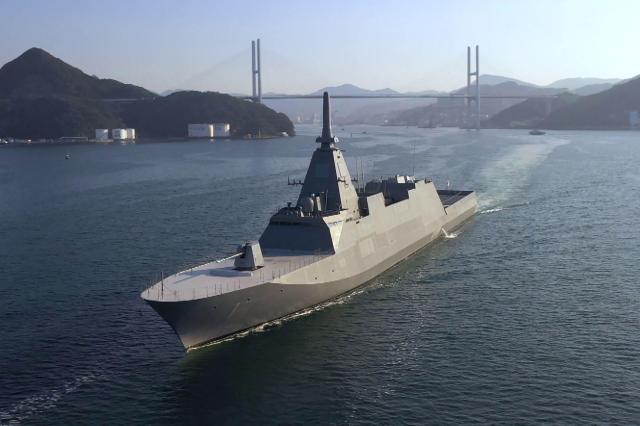
On April 18, Japan and Australia formally signed a contract to supply 11 upgraded Mogami-class frigates for the Royal Australian Navy. Three of these will be built in Japan by Mitsubishi Heavy Industries, while the remainder will be constructed in Australia starting in the early 2030s. Reuters described this as the most significant deal since Japan relaxed its arms export regulations in 2014. However, the Nikkei reported that prioritizing the three ships for Japan could delay the deployment of Self-Defense Forces vessels. The fact that even building just three ships may necessitate postponing domestic defense projects highlights that Japan's shipbuilding capacity is still insufficient.
South Korea's defense industry excels in pricing, delivery times, and mass production capabilities. Due to the geopolitical reality of the Korean Peninsula's division, South Korea has maintained a certain level of arms production and maintenance infrastructure even in peacetime, contributing to its competitiveness. While U.S. and European defense firms have shown limitations in pricing and delivery, South Korea has expanded its market by providing quality weapons at reasonable prices and in a timely manner.
Japan has largely remained outside this competitive landscape. However, with the lifting of the five-type restriction, this dynamic is beginning to change. While it will not be easy for Japan to catch up to South Korea's defense industry, the emergence of Japan as a variable in the competitive landscape that South Korea has enjoyed is evident.
* This article has been translated by AI.
Copyright ⓒ Aju Press All rights reserved.