

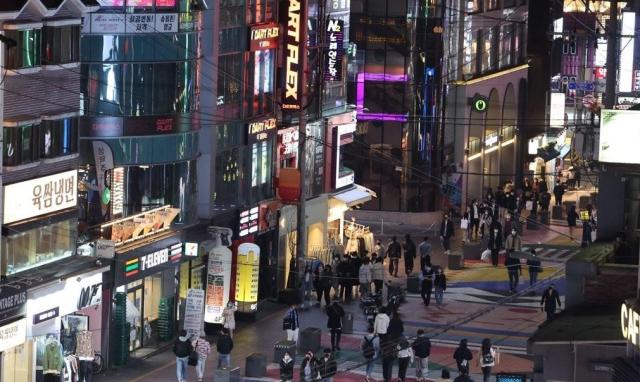
In the bustling commercial areas near Hongdae and Sinchon, foreign tourists have emerged as a key consumer demographic, prompting some office buildings to convert parts of their spaces into accommodations. This shift is attributed to the growing demand for lodging and tourism services driven by international visitors.
While sales in college areas have increased, the vacancy rates for small businesses have also risen. This trend is linked to a decline in the proportion of consumers in their 20s and the growing prevalence of delivery, online, and contactless shopping.
According to a report from Aju Economy on May 19, rental agreements for accommodations have recently been signed for several floors of the Master Building in Changcheon-dong, Seodaemun-gu. This building, which stands 10 stories tall and is located a four-minute walk from Hongdae Station, was previously the headquarters of Master Motors. After plans for a complete sale were abandoned, it was listed for rent starting in the fourth quarter of last year.
Rental prices have been steadily rising. Data collected by the commercial real estate service firm R Square shows that a rental listing in the Fidelia Tower, within walking distance of Sinchon Station, had a net operating cost (NOC) of 174,200 won per square meter in the third quarter of last year. This marks an increase from 142,500 won in the first quarter of 2022 and 170,800 won in the fourth quarter of 2024. NOC represents the total rental cost including management fees.
According to the Korea Real Estate Agency, the office vacancy rate in the Hongdae and Hapjeong areas was 6.1% in the first quarter of this year, higher than the Seoul average of 5.2%. However, it was below the city average in the third and fourth quarters of last year. Jeong Seon, CEO of Jeongseon Estate, noted, "Office rentals in this area are limited in supply, and large buildings that have been completed in the past three years have often been leased before they were even finished. With consistent demand, rental prices have been increasing by 3% to 5% annually."
As spending by foreign tourists increases, sales in the Hongdae area have also shown an upward trend. According to the Seoul Business Analysis Service, sales in the Hongdae area reached 618.7 billion won last year, a 30.1% increase from 475.5 billion won in 2021. Sales figures for the following years were 590.3 billion won in 2022, 626 billion won in 2023, and 635.9 billion won in 2024. According to Orange Square, which operates the Wowpass payment platform for foreign tourists, Hongdae ranks as the third most popular area for foreign tourist spending.
In contrast, the Sinchon area has seen a slowdown in growth. Sales in the Sinchon area were 331.2 billion won in 2021, 383.8 billion won in 2022, and 417 billion won in 2023, but dropped to 407.2 billion won in 2024 and 382.6 billion won last year, marking two consecutive years of decline. This disparity highlights differing trends in foreign tourist demand and foot traffic within the same college town.
However, the increase in sales has not benefited all local businesses equally. Since last year, the vacancy rate for small businesses in college areas has surged. Small businesses are defined as those with two stories or fewer and a total floor area of less than 330 square meters.
The vacancy rate for small businesses in the Hongdae and Hapjeong areas reached 14.2% in the third quarter of last year, more than tripling from 4.6% in the previous quarter. The vacancy rate remained in double digits at 13% in the first quarter of this year. The Sinchon and Ewha areas also recorded a vacancy rate of 15.1% in the third quarter of last year, maintaining that figure into the first quarter of this year, significantly higher than the 4.6% recorded in the second quarter of 2025.
The share of domestic consumers in their 20s, who were once the primary demographic in college areas, has also declined. In the Sinchon area, the revenue share from consumers in their 20s fell from 33.3% in 2021 to 27.2% last year. Similarly, in the Hongdae area, the share dropped from 47.9% in 2021 to 43.4% last year.
The end of the COVID-19 loan extension measures for small business owners and self-employed individuals in September of last year has also contributed to the financial burdens of struggling small stores, increasing their costs for loans and rent.
Lee Soo-jin, a researcher at the Consumer Trend Analysis Center at Seoul National University, stated, "The changes in consumer patterns are significant. The rise of delivery, online, and contactless shopping has reduced the frequency of in-person visits to stores."
She added, "The sharp increase in vacancy rates indicates that policy impacts are substantial. With the end of loan extensions for small business owners and self-employed individuals, the burden has increased for the most vulnerable stores."
* This article has been translated by AI.
Copyright ⓒ Aju Press All rights reserved.