

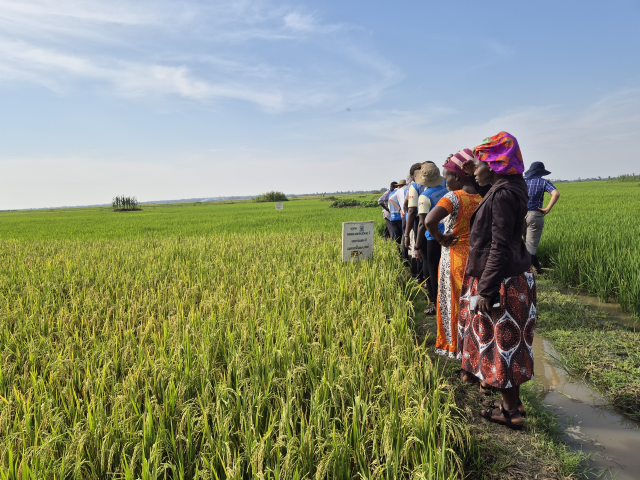
A South Korean government official provides rice seed training to locals in Uganda [Photo=Ministry of Agriculture, Food and Rural Affairs]
The K-Rice Belt initiative, aimed at producing and distributing rice seeds in African countries with weak rice production bases, is progressing well, exceeding its initial production targets.
On May 21, the Ministry of Agriculture, Food and Rural Affairs announced that through the K-Rice Belt initiative, a total of 6,365 tons of high-quality, high-yield rice seeds were produced last year across seven African countries.
The production figures for the seven countries are as follows: Uganda 3,670 tons, Ghana 739 tons, Guinea 723 tons, Senegal 587 tons, Gambia 431 tons, Kenya 155 tons, and Cameroon 60 tons.
The total rice seed production of 6,365 tons surpassed the target of 4,752 tons by 34%. Over the past three years, the cumulative production has reached 12,248 tons, exceeding 10,000 tons.
The average yield per hectare is also promising, with an average of 4.6 tons per hectare, more than double the local traditional cultivation yield of 2.2 tons. This represents an improvement of over 15% compared to last year's average of 4 tons.
Of the 6,365 tons of rice seeds produced, 1,633 tons from the first crop will be prioritized for distribution to farmers and vulnerable populations in collaboration with local governments. The remaining 4,732 tons from the second crop will also be distributed following consultations with the target countries.
Additionally, the government is working on establishing seed production infrastructure as part of the K-Rice Belt initiative. Through the Korea Rural Community Corporation, a total of 520 hectares of rice seed production complexes are being developed in the seven African countries, with essential agricultural infrastructure such as land leveling, irrigation and drainage systems, and reservoirs being constructed according to local conditions.
Receiving strong support from local governments and farmers, the government plans to expand the initiative by adding Sierra Leone as a new participating country, increasing the total from seven to eight countries.
Jung Yong-ho, the International Agricultural Cooperation Officer at the Ministry of Agriculture, Food and Rural Affairs, stated, "The K-Rice Belt initiative has achieved stable seed production results for three consecutive years, gradually establishing a foundation for the project in each country. We aim to develop it into a representative agricultural official development assistance (ODA) model that contributes to overcoming food crises and enhancing food security in Africa."
On May 21, the Ministry of Agriculture, Food and Rural Affairs announced that through the K-Rice Belt initiative, a total of 6,365 tons of high-quality, high-yield rice seeds were produced last year across seven African countries.
The production figures for the seven countries are as follows: Uganda 3,670 tons, Ghana 739 tons, Guinea 723 tons, Senegal 587 tons, Gambia 431 tons, Kenya 155 tons, and Cameroon 60 tons.
The total rice seed production of 6,365 tons surpassed the target of 4,752 tons by 34%. Over the past three years, the cumulative production has reached 12,248 tons, exceeding 10,000 tons.
The average yield per hectare is also promising, with an average of 4.6 tons per hectare, more than double the local traditional cultivation yield of 2.2 tons. This represents an improvement of over 15% compared to last year's average of 4 tons.
Of the 6,365 tons of rice seeds produced, 1,633 tons from the first crop will be prioritized for distribution to farmers and vulnerable populations in collaboration with local governments. The remaining 4,732 tons from the second crop will also be distributed following consultations with the target countries.
Additionally, the government is working on establishing seed production infrastructure as part of the K-Rice Belt initiative. Through the Korea Rural Community Corporation, a total of 520 hectares of rice seed production complexes are being developed in the seven African countries, with essential agricultural infrastructure such as land leveling, irrigation and drainage systems, and reservoirs being constructed according to local conditions.
Receiving strong support from local governments and farmers, the government plans to expand the initiative by adding Sierra Leone as a new participating country, increasing the total from seven to eight countries.
Jung Yong-ho, the International Agricultural Cooperation Officer at the Ministry of Agriculture, Food and Rural Affairs, stated, "The K-Rice Belt initiative has achieved stable seed production results for three consecutive years, gradually establishing a foundation for the project in each country. We aim to develop it into a representative agricultural official development assistance (ODA) model that contributes to overcoming food crises and enhancing food security in Africa."
* This article has been translated by AI.
Copyright ⓒ Aju Press All rights reserved.