

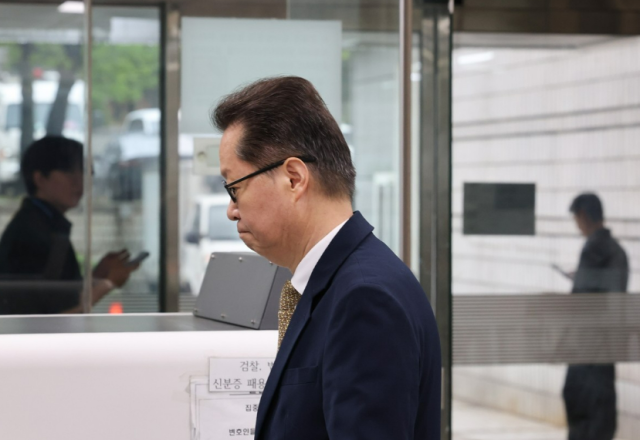
Lee Eun-woo, the former head of the Korea Policy Broadcasting System (KTV), faces a critical moment as he is accused of insurrection propaganda related to the December 3 martial law. This marks the first attempt by the second comprehensive special investigation team, led by Special Prosecutor Kwon Chang-young, to secure an arrest warrant, focusing on a charge that lacks legal precedent.
The Seoul Central District Court, presided over by Chief Judge Lee Jong-rok, began the warrant hearing at 10 a.m. on May 21 to assess the necessity of Lee's arrest.
Lee arrived at the court at 9:16 a.m. dressed in a black suit, heading straight to the courtroom without responding to questions from reporters.
Special Prosecutors Kwon Young-bin and Kim Jung-min attended the hearing. Kwon stated to reporters outside the court, "The citizens who rushed to the National Assembly were the key figures in stopping the insurrection on December 3. The act of continuing to propagate insurrection against such citizens must be severely punished."
He added, "We have confirmed the charges by supplementing aspects that were not investigated in the first insurrection special investigation, and given the seriousness of the matter, we filed for the warrant. It was particularly necessary to verify the fairness and objectivity of the media among government agencies."
Lee is accused of repeatedly broadcasting news that justified the martial law and related proclamations from December 3 to 13, 2024, while selectively blocking or deleting news that criticized or attempted to halt the martial law, thereby propagating insurrection.
The comprehensive special investigation team claims that Lee continued to support and protect insurrection forces, including former President Yoon Suk Yeol, even after the martial law was lifted, leading to the warrant request on May 18. This is the first arrest warrant request in the 82 days since the special investigation team was established.
The key issue in this case is whether the charge of insurrection propaganda can be substantiated. There is no precedent for this charge being recognized as a valid reason for arrest, making the court's decision highly anticipated.
Kwon emphasized, "There is currently no precedent for insurrection propaganda charges, and this is the first attempt by the comprehensive special investigation team. We will explain to the court that insurrection propaganda is a significantly serious criminal act."
The special investigation team argues that the essence of the case lies not merely in the direction of reporting but in the fact that a state-run broadcaster justified an unconstitutional martial law and continued to support it. In contrast, Lee's defense team asserts that KTV's role is to promote policies and denies the allegations, questioning whether the broadcasts can be interpreted as promoting insurrection and legitimizing it.
Lee's defense reportedly submitted a 100-page opinion document in preparation for the hearing, stating, "KTV's identity is that of a policy promotion broadcaster," and questioning the interpretation of its broadcasts as promoting insurrection.
The relationship with previous trials is also a major point of contention.
Previously, the insurrection special investigation team (led by Special Prosecutor Jo Eun-seok) charged Lee with abuse of authority for ordering the deletion of KTV subtitles containing statements from politicians criticizing the constitutionality and legality of the martial law shortly after it was declared. Lee was indicted without detention in December of last year, and the case is currently awaiting a first-instance verdict on June 26, following a sentencing hearing on May 15.
At that time, the insurrection special investigation team decided not to prosecute on the charge of insurrection propaganda, citing the timing of the offense and the potential chilling effect on press freedom.
However, the comprehensive special investigation team decided to reopen the investigation after reviewing the case records and confirming evidence that Lee supported insurrection forces even after the martial law was lifted.
This has led to concerns in the legal community about potential "double prosecution," as some argue that the same actions are being investigated again while a trial is ongoing.
The special investigation team strongly refuted this claim. Kwon stated, "The term double prosecution is something said by those who do not understand the law. Given the protected legal interests, the nature of the acts, and the social facts, this is a separate case and does not constitute double prosecution."
The court is expected to consider the degree of evidence supporting the charges, the similarity to existing cases, and the extent to which journalistic actions can be subject to criminal penalties during the warrant hearing.
This hearing is anticipated to be a turning point for the comprehensive special investigation. If the warrant is issued, the investigation can accelerate into the involvement of state agencies and public media before and after the martial law. Conversely, if denied, it could raise questions about the validity of applying a charge of insurrection propaganda without precedent and significantly hinder the investigation's momentum.
A decision on Lee's arrest could be made as early as that evening.
* This article has been translated by AI.
Copyright ⓒ Aju Press All rights reserved.