

[Source: National Data Agency]
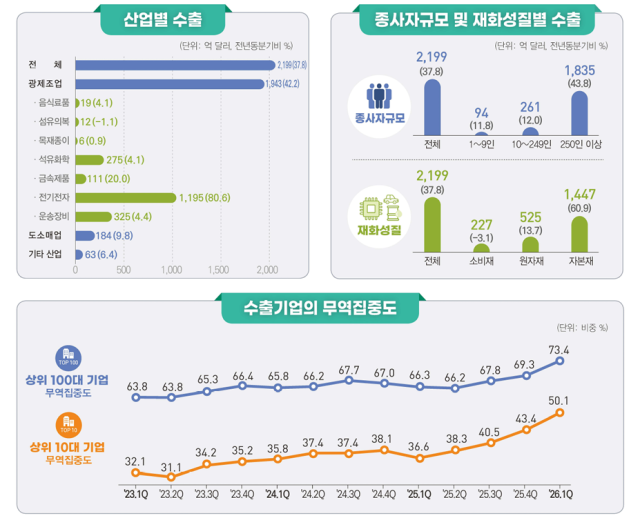
The ongoing boom in semiconductor exports is intensifying the concentration of exports among a few large companies in South Korea. In the first quarter of this year, the trade concentration of the top 10 exporting companies surpassed 50% for the first time, reaching a record high.
According to the "Q1 2026 and Annual Company Characteristics Trade Statistics" released on May 10 by the National Data Agency and the Korea Customs Service, the trade concentration of the top 10 exporting companies was recorded at 50.1%. This marks a 13.5 percentage point increase compared to the same period last year and is the highest level since the statistics began in 2010.
The trade concentration among the top 100 companies also rose to 73.4%, an increase of 7.2 percentage points from the previous year, further highlighting the dominance of these firms, which now account for more than half of total exports, while the top 100 companies represent over 70%.
This trend is largely attributed to the booming electrical and electronics sector, particularly semiconductors. In fact, the export of the manufacturing sector surged by 42.2% compared to the same period last year, driven by significant increases in the electrical and electronics and metal products sectors.
By company size, exports increased across large, medium, and small enterprises, but the growth rates varied significantly. Large companies saw their exports rise by 52.9% year-on-year, demonstrating a robust increase, primarily due to the rise in capital goods and raw material exports.
In contrast, medium-sized enterprises experienced a modest export increase of 7.4%, while small businesses saw a 10.7% rise. Medium-sized firms reported growth in capital goods, raw materials, and consumer goods, while small businesses showed increases across all categories.
In addition to the manufacturing sector, retail exports grew by 9.8%, and other industries saw a 6.4% increase. Although sectors like information and communication and construction experienced declines, transportation and warehousing, along with facility management, showed growth.
Exports also increased across all employee size categories. Companies with 250 or more employees reported a 43.8% increase in exports, while those with 10 to 249 employees saw a 12.0% rise, and firms with 1 to 9 employees experienced an 11.8% increase. This indicates a pronounced export growth trend among large companies.
Imports also continued to rise. In the first quarter of this year, imports increased by 8.6% for large companies, 13.5% for medium-sized firms, and 14.5% for small businesses, reflecting a general expansion in capital goods, raw materials, and consumer goods imports.
By industry, imports in the manufacturing sector rose by 8.6%. Although the petrochemical sector saw a decline, increased imports of electrical and electronics and metal products offset this drop. Retail imports surged by 17.4%, while other industries, particularly transportation and public administration, increased by 8.5%.
Import growth was also noted across all employee size categories, with companies employing 250 or more workers increasing imports by 9.2%, those with 10 to 249 employees by 14.1%, and firms with 1 to 9 employees by 15.9%. Notably, small businesses saw increases in imports related to wholesale, metal products, and transportation and warehousing.
According to the "Q1 2026 and Annual Company Characteristics Trade Statistics" released on May 10 by the National Data Agency and the Korea Customs Service, the trade concentration of the top 10 exporting companies was recorded at 50.1%. This marks a 13.5 percentage point increase compared to the same period last year and is the highest level since the statistics began in 2010.
The trade concentration among the top 100 companies also rose to 73.4%, an increase of 7.2 percentage points from the previous year, further highlighting the dominance of these firms, which now account for more than half of total exports, while the top 100 companies represent over 70%.
This trend is largely attributed to the booming electrical and electronics sector, particularly semiconductors. In fact, the export of the manufacturing sector surged by 42.2% compared to the same period last year, driven by significant increases in the electrical and electronics and metal products sectors.
By company size, exports increased across large, medium, and small enterprises, but the growth rates varied significantly. Large companies saw their exports rise by 52.9% year-on-year, demonstrating a robust increase, primarily due to the rise in capital goods and raw material exports.
In contrast, medium-sized enterprises experienced a modest export increase of 7.4%, while small businesses saw a 10.7% rise. Medium-sized firms reported growth in capital goods, raw materials, and consumer goods, while small businesses showed increases across all categories.
In addition to the manufacturing sector, retail exports grew by 9.8%, and other industries saw a 6.4% increase. Although sectors like information and communication and construction experienced declines, transportation and warehousing, along with facility management, showed growth.
Exports also increased across all employee size categories. Companies with 250 or more employees reported a 43.8% increase in exports, while those with 10 to 249 employees saw a 12.0% rise, and firms with 1 to 9 employees experienced an 11.8% increase. This indicates a pronounced export growth trend among large companies.
Imports also continued to rise. In the first quarter of this year, imports increased by 8.6% for large companies, 13.5% for medium-sized firms, and 14.5% for small businesses, reflecting a general expansion in capital goods, raw materials, and consumer goods imports.
By industry, imports in the manufacturing sector rose by 8.6%. Although the petrochemical sector saw a decline, increased imports of electrical and electronics and metal products offset this drop. Retail imports surged by 17.4%, while other industries, particularly transportation and public administration, increased by 8.5%.
Import growth was also noted across all employee size categories, with companies employing 250 or more workers increasing imports by 9.2%, those with 10 to 249 employees by 14.1%, and firms with 1 to 9 employees by 15.9%. Notably, small businesses saw increases in imports related to wholesale, metal products, and transportation and warehousing.
* This article has been translated by AI.
Copyright ⓒ Aju Press All rights reserved.