

On May 21, KDI released a report titled "The Direction of Retail Policy Suggested by the Transition of Mandatory Closing Days to Weekdays." The institute compiled data on the adjustment of mandatory closing days across local governments and analyzed monthly credit card transaction data from Shinhan Card between 2015 and 2024.
Sales at large supermarkets increased from 26.4 trillion won in 2006 to 39.5 trillion won in 2014, but then began to decline, dropping to 28.3 trillion won in 2023. The number of stores also grew from 2006 to 2012, but the growth rate has since slowed, with a recent trend of decline. This reflects a shift in the operational model of large supermarkets from expansion to structural adjustment.
In this context, Daegu became the first city to change its mandatory closing day to Monday in 2023. Following this, other cities such as Cheongju, Seoul, Busan, and Gyeonggi have also mandated that large supermarkets close on weekdays.
The government has announced plans to transition mandatory closing days to weekdays in 2024, creating an environment that allows for more flexible decision-making regarding closing days.
The number of cities and districts that have made this transition increased from eight in February 2023 to about 30 by February 2025, with the number of large supermarkets affected rising from 18 to 67. Notably, the increase has been particularly pronounced since mid-2024.
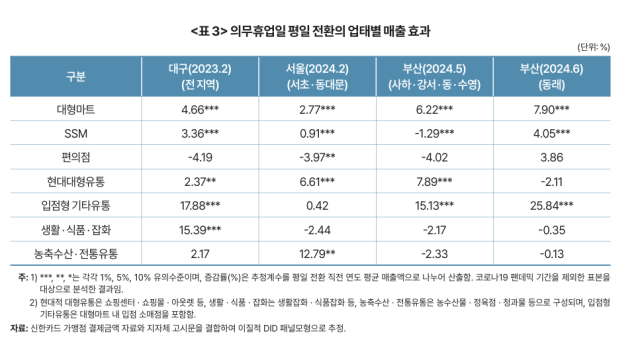
The analysis revealed that sales at large supermarkets increased across major regions, including Daegu, Busan, and Seoul. Specifically, sales rose by 4.7% in Daegu, 2.8% in Seoul (Seocho and Dongdaemun), and between 6.2% and 7.9% in Busan. This increase suggests a partial recovery in consumer spending that had been constrained by previous weekend operating restrictions.
Lee Jin-guk, a senior researcher at KDI, stated, "Dual-income households or families with children find it difficult to shop at large supermarkets unless it’s on the weekend. The transition to weekdays has expanded consumer convenience, allowing shopping on weekends, which has contributed to the increase in sales at large supermarkets."
Sales increases were also confirmed at semi-large stores (SSM), which are directly affected by the mandatory closing day regulations. In Daegu, sales rose by approximately 3.4%, while in Busan's Dongnae District, the increase was 4.1%.
Furthermore, the analysis found that weekend operations at large supermarkets did not lead to a decrease in sales at traditional markets. KDI interprets this as evidence that traditional markets operate as independent retail channels, competing only in certain areas rather than being direct substitutes for large supermarkets.
However, in regions where there is a high degree of substitution between offline stores or where online shopping is not prevalent, the increase in large supermarket sales could potentially lead to a decline in traditional market sales.
Since the transition to weekdays for mandatory closing days, online payment amounts have decreased by 2.9%. This suggests that improved access to offline retail, including large supermarkets, has led to a shift in some consumer spending from online to offline.
KDI believes that rather than negatively impacting traditional markets, the weekend operations of large supermarkets can stimulate consumer linkage effects, and thus policies should be developed to connect the two sectors.
The senior researcher noted, "In areas like Seocho and Dongdaemun in Seoul, where many traditional markets exist, the weekend operations of large supermarkets appear to draw consumers to nearby traditional markets, creating linked consumption. Instead of merely restricting large supermarket operations, it may be more effective to develop strategies that integrate visitors to large supermarkets with traditional markets for mutual benefit."
* This article has been translated by AI.
Copyright ⓒ Aju Press All rights reserved.