

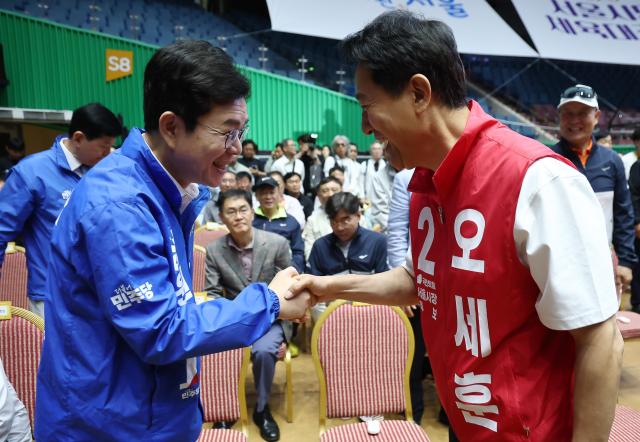
As the local elections approach in 12 days, the race for Seoul mayor is becoming increasingly competitive. Recent polling indicates that Oh Se-hoon, the candidate from the People Power Party, is narrowly leading Jung Won-o of the Democratic Party within the margin of error, making him a key player in the final stretch of the campaign.
According to a poll released on May 22, Oh garnered 44.8% support, while Jung received 42.0%. The gap between the two candidates stands at 2.8 percentage points, which falls within the margin of error of ±3.1 percentage points.
The survey, conducted by ResearchWell on behalf of New Daily from May 20 to 21, included responses from 977 residents of Seoul aged 18 and older.
In this poll, Kim Sung-cheol from the Reform Party received 2.1%, while other candidates collectively garnered 2.6%. Additionally, 6.1% of respondents indicated they did not support any candidate, and 2.4% were unsure.
Support for the candidates varied by gender, with Oh performing better among male voters and Jung receiving more support from females. Oh led with 50.5% among men, compared to Jung's 38.7%. Conversely, Jung had 45.0% support among women, while Oh received 39.6%.
Age demographics also showed distinct patterns. Jung was favored among voters in their 40s and 50s, while Oh had strong support among those in their 20s, 30s, and seniors over 70. Notably, Oh achieved over 50% support in the 30s (57.1%) and among seniors (51.2%). Jung, on the other hand, received 58.5% support from voters in their 40s and 57.7% from those in their 50s.
Regionally, Oh's advantage was particularly pronounced in the southeastern districts, a traditional conservative stronghold. In the four districts of Seocho, Gangnam, Songpa, and Gangdong, Oh received 52.0% support, leading Jung by 13.6 percentage points (38.4%).
In contrast, in the first district, which includes Jongno, Jung received 43.0%, slightly ahead of Oh's 40.1%.
When asked about their reasons for supporting the candidates, both groups exhibited significant 'negative preference' dynamics. Among Jung's supporters, 28.8% cited dislike for the People Power Party, while 27.3% supported him because they liked President Lee Jae-myung, and 22.4% liked Jung himself. For Oh's supporters, 29.7% indicated they were motivated by dislike for President Lee, 27.8% liked Oh, and 17.1% disliked the Democratic Party.
Regarding past allegations of violence against Jung, 43.6% of Seoul residents felt that further clarification was necessary. Only 17.8% believed the issue had been sufficiently addressed, while 18.9% thought it did not require clarification as it was a political attack.
Meanwhile, 54.1% of Seoul residents rated President Lee's governance positively, while 39.5% expressed disapproval. Party support showed the Democratic Party at 41.0% and the People Power Party at 36.8%.
The survey utilized automated response technology (ARS) with wireless virtual numbers provided by three telecommunications companies, achieving a response rate of 5.9%. The margin of error is ±3.1 percentage points at a 95% confidence level. More details can be found on the Central Election Polling Review Committee's website.
* This article has been translated by AI.
Copyright ⓒ Aju Press All rights reserved.