

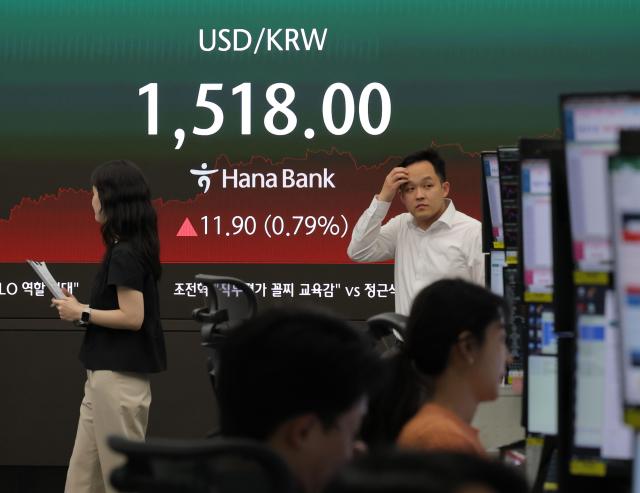
The won-dollar exchange rate has approached the 1520 won mark, prompting foreign exchange authorities to intervene verbally to stabilize the currency. The exchange rate finished the week at a high level, the highest in about a month and a half since April 2.
The Bank of Korea and the Ministry of Economy and Finance issued a joint message shortly before the close of trading in the Seoul foreign exchange market, stating, "The foreign exchange authorities are monitoring the movement of the won-dollar exchange rate, which appears excessive compared to fundamentals, with caution." They added, "We will take decisive action if necessary."
On that day, the exchange rate for the won against the U.S. dollar closed at 1517.2 won, up 11.1 won from the previous session. This is the highest closing figure since April 2, when it was 1519.7 won.
The exchange rate opened at 1504.7 won, down 1.4 won, but quickly turned upward, increasing its gains in the afternoon. At one point during the day, it reached 1519.4 won, nearing the 1520 won level. The intraday high was also the highest since April 2, when it reached 1524.1 won.
International oil prices, which had fallen overnight, rose in the Asian market, triggering a flight to safer assets. In Asian trading, the price of West Texas Intermediate (WTI) crude oil for July delivery rose by 1.84% to $98.11 per barrel.
Uncertainty surrounding peace negotiations between the U.S. and Iran has contributed to rising international oil prices. Reports indicated that Iran's Supreme Leader Ayatollah Ali Khamenei instructed against exporting highly enriched uranium abroad, dampening expectations for peace.
Meanwhile, U.S. President Donald Trump reaffirmed the U.S. position on securing Iran's highly enriched uranium, indicating that both sides remain at an impasse on this issue.
Foreign investors sold a significant amount of domestic stocks, with net sales totaling 1.9223 trillion won in the stock market that day. This marks the 12th consecutive trading day of net selling.
The weakening of the yen also played a role. The yen-dollar exchange rate rose by 0.15 yen to 159.10 yen per dollar. The Japanese government is considering additional budget measures in response to the prolonged instability in the Middle East, contributing to the yen's decline.
Lee Jin-kyung, a researcher at Shinhan Investment Corp., stated, "The won-dollar exchange rate is under pressure from a strong dollar externally and uncertainty regarding peace negotiations, which is exerting downward pressure on the won. The continued net selling of domestic stocks by foreign investors has created an environment favoring dollar purchases, which is also linked to the weakness of Asian currencies like the yen."
* This article has been translated by AI.
Copyright ⓒ Aju Press All rights reserved.