

The Ministry of the Interior and Safety has announced that the total number of registered voters for the June 3 local elections is 44,649,908. This figure represents an increase of over 340,000 from the 2022 local elections and is also higher than the number of voters in last year's presidential election. While these numbers may seem like mere statistics, they encapsulate the direction in which South Korea is heading.
The concentration in the metropolitan area, deepening aging, the crisis of regional extinction, and the transition to a multicultural society are all reflected in the voter registration data. This local election is not just about electing regional heads and local officials; it serves as a critical test for determining the future structure of South Korea.
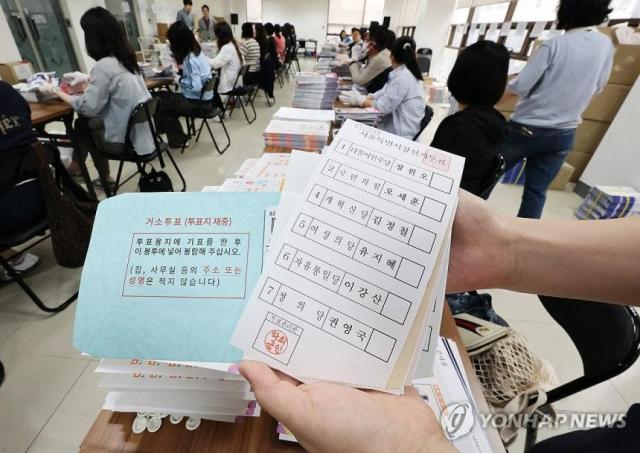
The most striking aspect is the concentration in the metropolitan area. Voters in Gyeonggi Province number over 11.87 million, accounting for 26.6% of the total. When combined with Seoul and Incheon, the proportion of voters in the metropolitan area approaches nearly half. This explains why election issues are primarily focused on topics such as the GTX transit system, redevelopment, real estate, and transportation networks. Politicians are inevitably drawn to the sentiments of metropolitan voters, making the elections for the Seoul mayor and Gyeonggi governor akin to major political events.
The issue is that this concentration is not merely a matter of population movement. Young people, jobs, capital, industries, education, and culture are all being drawn into the metropolitan area. Regions are suffering from a triple burden of population decline, weakened industrial bases, and youth outflow. Local universities face existential threats, and regional economies are collapsing. The term "regional extinction" has become a stark reality rather than an exaggeration.
This prompts a reflection on why the Roh Moo-hyun administration prioritized balanced regional development as a national strategy. Although the policies for innovation cities and the relocation of public institutions sparked considerable debate, the recognition of the problem was not misplaced. The overcrowding in the metropolitan area and the hollowing out of regions represent a structural crisis that threatens the sustainability of the entire nation. A country that allows only specific regions to thrive will ultimately lose its balance. If regions collapse, national competitiveness will also weaken.
Another reality highlighted by the voter registration statistics is aging. Among the age groups, those in their 50s make up 19.3%, while the combined total of those in their 60s and 70s exceeds 34%. In contrast, voters in their 20s account for just over 12%, and those in their teens are around 2%. This suggests that South Korean politics may increasingly shift focus from future industries and innovations to stability, welfare, and asset protection. Issues such as pensions, healthcare, real estate, and safety are likely to become central political topics.
Japan has already traversed this path. The focus of Japanese politics, even amid long-term stagnation, has shifted toward stability policies for the elderly rather than bold structural reforms, driven by a super-aged voter demographic. South Korea is moving in a similar direction. The challenge lies with the younger generation, which is suffering the most from job and housing crises and risks being marginalized politically. As politics becomes more sensitive to current stability rather than future prospects, the nation’s innovative momentum is bound to weaken.
The increase in foreign voters is also a significant change. The number of foreign voters in the local elections has surpassed 150,000, more than tripling since 2014. This signals that South Korea is already transitioning into a multicultural industrial nation. The ongoing debates over foreign voting rights in local elections are intertwined with changes in industrial and demographic structures.
Europe has already experienced similar challenges. In Germany and France, local politics have been shaken by the intertwining of immigration and regional economic issues. South Korea is now entering an era where the question of "who is a local resident?" cannot be avoided. However, the political sphere still tends to view this issue solely through the lens of short-term electoral calculations. There is a lack of discussions on long-term population strategies and industrial policies.
This local election sends a clear message to the political sphere. If local elections devolve into mere judgments of power or ideological confrontations, regions will inevitably suffer further decline. The essence of local elections lies in regional competitiveness. Cities must compete over which can create better jobs, which local governments can retain youth, and which regions can connect industries, education, and transportation to establish sustainable growth foundations.
However, the reality remains trapped in the shadow of central politics. Inter-party conflicts take precedence over regional development strategies, and discussions of central power judgments overshadow local policies. As long as local elections are consumed as proxy battles for central politics, local autonomy will become merely a shell. Ultimately, the burden will fall on local residents and regional economies.
South Korea currently stands at a significant structural transition. It is simultaneously moving toward a super-concentrated metropolitan area, an ultra-aged society, and a multicultural industrial nation. The voter registration statistics for this local election illustrate this reality in numbers. The important thing is not the numbers themselves but the warnings they convey.
The 44,649,908 voters represent more than just a tally of ballots; they signal a collective indication of where South Korea is headed. If the political sphere ignores this warning, the future of regions will remain bleak, even as local elections continue. It is time to reaffirm the fundamental understanding that revitalizing regions is essential for saving the nation.
* This article has been translated by AI.
Copyright ⓒ Aju Press All rights reserved.